Back in 2006, Tompkins Square, one of the world’s leading acoustic guitar, jazz and archival folk labels, released a compilation called Berkeley Guitar. The LP showcased the playing of three up-and-coming young guitarists : Matt Baldwin, Adam Snider and Sean Smith, who also assembled and produced the collection. The disc made it clear that the American Primitive guitar tradition, first popularized (I know, relative term) by now-legends like John Fahey and Peter Lang in the 60’s, was still alive and well in Berkeley in the new century.
On June 8, 2010, Tompkins Square will release a second installment, aptly titled Beyond Berkeley Guitar. This new collection was once again curated by Smith, and as the name suggests, the parameters have been expanded… Beyond Berkeley Guitar features the work of seven guitarists from the greater Bay area, and the music of these players covers a wider range of sounds, styles, and techniques, both compositional and philosophical.
The players’ geographic proximity results in only a little overlap in their approaches to solo guitar music… from the Robbie Basho-inspired, free-raga meditations of Rich Osborn to the kinetic, bluesy electric runs of Ava Mendoza, from Smith’s multi-movement psychedelic journeys to the more tightly wound, succinct opening statement by Aaron Sheppard… there is a lot of variety on offer, and the twists and turns all add up to make Beyond Berkeley Guitar not only a wonderful snap-shot (polaroid?) of a vibrant guitar scene, but also a great record in its own right.
With the help of Smith and the label, I was fortunate enough to get interviews with everyone who appears on Beyond Berkeley Guitar. For me, these interviews were both exciting and fascinating. The players who appear on this collection are all fantastic guitar players, there’s no doubt about it… but I was delighted (though not surprised) to find that they are all thoughtful, warm and intelligent people, happy to share their thoughts on the instrument, composition, the rich tradition of instrumental guitar music and its welcome resurgence.
The interviews will be posted one per day, starting tomorrow with Aaron Sheppard. There is little or no editing, in most cases. One important note : though I would usually provide a sound sample with any given interview or record review, each player only has one track on Beyond Berkeley Guitar… and I wouldn’t want to give everything away, just like that! I want to strongly encourage fans of finger-picked guitar music to pick up this release, you won’t regret it! Please enjoy the interviews.
Last month, Strange Attractors Audio House reissued Sean Smith’s terrific album, Eternal.¹ Where Sean’s prior recordings: the self-titled LP, Sacred Crag Dance, Corpse Whisperer, and contributions to Berkeley Guitar, established him at the forefront of the underground solo guitar scene, Eternal reveals him to be a gifted arranger as well. Most of the album finds Smith in ensemble with combinations of Adam Snider, Fletcher Tucker and Angela Hsu on stringed instruments (violin, mountain dulcimer, banjo, etc) and Spencer Owen on percussion (claves, sandpaper blocks, drum kit, etc). As with his solo work, Sean takes on a number of different folk styles, and the ensembles allow him to superimpose a variety of textures. The result is an album that is as entertaining as it is challenging, which cannot always be said of offerings from even the most talented instrumentalists. Continue reading →
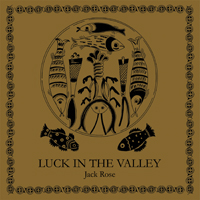
Performing is a musician’s most reliable path to the mastery of technique and ideas. The late Jack Rose constructed his solo guitar repertoire through years of persistent touring to become one of the commanding players of our generation. His 2005 album, Kensington Blues, presented eight selections that would serve as prototypes for his subsequent work, and a guitar vocabulary that was both deep-rooted and deliberately limited. Jack did not dabble, at least in public (he once told me that he played “Blackwaterside” now and then for a kick or as a warm-up). Instead, he continually explored variations of his core ideas. On his ultimate album, Luck In The Valley, he works primarily in ensemble with a cast that includes Glenn Jones, The Black Twig Pickers, Harmonica Dan and Hans Chew.
Jack’s work on the Weissenborn is the part of his repertoire I enjoy most. He used lap slide conventionally, for blues solos, but would also turn to it for modal, rāga-like excursions like “Now That I’m A Man Full Grown II” (from Kensington Blues) and “Song For The Owl” (from the limited edition 2009 LP, The Black Dirt Sessions). Luck In The Valley opens with a selection in this mold, entitled “Blues For Percy Danforth.” Jack’s slide on the take is charged and immediate, while an accompaniment of jaw harp and harmonica cleverly approximates sitar overtones. Within the context of the current guitar underground, where there is no shortage of Hindustani exotica, this cut strikes me as a revelation:
As “Danforth” fades, the album turns on a dime into “Lick Mountain Ramble,” the first of several rowdy ensemble pieces described in the press notes as “three-track shack recordings.” These tunes are elemental, joyful and beautifully presented. Jack’s “boom-chick” is the pervasive force, but is never artificially favored in the mixes, which are appropriately roomy and not over-engineered. My favorite is “When Tailgate Drops, The Bullshit Stops” (of course, though, I’m a sucker for the title)
“Tree In The Valley,” from the latter half of the album, is the second rāga-style work and one of only two solos, played in the manner of Robbie Bãsho’s “A North American Raga (The Plumstar)” (from 1971’s Song Of The Stallion LP) and Jack’s own “Cross the North Fork” (originally from Kensington Blues, with alternate takes on Tompkins Square’s Imaginational Anthem Volume 2 compilation of 2006 and also The Black Dirt Sessions). What I think Rose brings to this type of guitar playing that most others have not is an unwavering sense of resolve: there is never a moment’s hesitation, never a loss of direction. He also brings near-flawless execution, and so absent are the missed and bum notes that could jar the listener from reverie.
While Kensington Blues will likely endure as Jack’s signature work, Luck In The Valley, his best since, is a worthy, multifaceted companion.
Scottish guitarist Ben Reynolds is getting ready to embark on a quick US tour. We reviewed his Tompkins Square debut How Day Earnt Its Night not too long ago, and have since been spinning his Strange Attractors album Two Wings, which is equally good! We’re going to try to take some video at the Pittsburgh performance, so keep an eye out for that… and visit Reynolds’ Myspace page for updates on the TBA dates.
I first discovered Tim Buckley about ten years ago, when a band-mate played me the sublime Happy Sad album. It was something of a revelation, on par with The Zombies’ Odessey and Oracle, The Beach Boys’ Pet Sounds or Love’s Forever Changes… each of these records was able to penetrate my mistrust for classic rock and hippie-dippy affectations by offering up innovative production, unusual blends of acoustic and electric instruments, and acute musicality. Happy Sad had a vibe all its own, with David Friedman’s atmospheric washes of vibraphone and guitarist Lee Underwood’s jazzy, wandering leads… and then there was the singer, with his elastic, transcendent voice… I hadn’t heard anything like it before. I was hooked, and still remember making a point of telling everyone I knew about Tim Buckley. “Now that’s a singer!”
I was very excited when I found out that a new Buckley live document was in the offing, since his Dream Letter : Live In London 1968, Peel Sessions and subsequent Once I Was discs have always remained rewarding listens. Many fans prefer live Tim Buckley to the comparably inconsistent studio albums, including Tompkins Square label head Josh Rosenthal… and I knew that if Rosenthal was involved, Live At The Folklore Center – March 6, 1967 must be a significant recording. The story of how he came into the master tape is a fascinating one, and is recounted in detail in this Onion AV Club interview from a few weeks back. Tompkins Square is known for delivering impressive bang for the buck, and this package features rare archival photos and an unreleased interview with the singer. At 55 minutes, and featuring 6 never-released Buckley compositions, this important addition to his discography should be an easy sell for even casual fans.
…and an important recording it is. Live At The Folklore Center… captures a young Tim Buckley performing to a captive audience in an almost unbelievably intimate setting, the Folklore Center at 321 Sixth Ave in New York City. Attendance was between 30 and 40 people, and the recording was undertaken by Izzy Young, a dedicated NYC folk music enthusiast. The fidelity here is remarkably good, and though the “mix” is a little boomy guitar-wise, this proves a minor quibble. Everything about Tim Buckley, still in the formative stages of his short career, comes through loud and clear… including the fragile person behind the otherworldly voice.
Aside from the previously unreleased compositions, the songs are culled almost exclusively from Buckley’s first two studio albums, the date of the performance falling between the release of his self-titled debut and the recording of his second, Goodbye and Hello. The tracks that appeared on Tim Buckley tend to fare very well in the man-and-his-guitar context… From the outset, the setting appears casual enough, and Buckley nervously wonders whether the tape recorder will pick up his singing. Though this shy, nervous Buckley will reappear in stage banter throughout the set, he all but disappears in the opening chords of “Song For Janie”. With energetic strumming and sufficient guitar flourishes, the tune holds up well in this stripped-down setting.
Tim Buckley – “Song For Janie” .
In “I Can’t See You”, Buckley wrestles with his guitar falling out of tune, but the song easily rises above some of Buckley’s other Elektra-era folk-pop by using an interesting verse structure and a dissonant, wordless chorus. “Aren’t You The Girl” has some of the most effective guitar accompaniment of the night, and even though the chord choices don’t vary greatly from the other songs, Buckley keeps it interesting by peppering his uptempo strumming with quick arpeggios and decending bass figures.
“Wings”, though, is unable to improve on the album version. The strumming feels heavy-handed, even when Buckley (briefly) attempts to soften the song’s dynamic toward the end of the track. The album’s string arrangement, saccharin as it was, had a way of nicely filling the spaces between the verses. The faster tempo of this version feels somewhat rushed.
The set performed on Live At The Folklore Center… isn’t perfectly paced or executed, far from it… the setlist is a long one, and there isn’t much variety in approach, technique or lyrical content on Buckley’s part. The songs that would soon appear on sophomore album Goodbye & Hello sound a little hollow here, bereft of their studio treatments. One gets the feeling that these were written in/for the studio, where the band and producers could run wild with the bubblegum-psych production embellishments that were coming into vogue at the time. In several cases, the lack of ear-candy lays bare the relatively flowery and ambiguous nature of Buckley’s lyrics. “Troubadour” features more than a few psych-pop clichés… “No Man Can Find The War” sits as awkwardly in this set as it does as the opener of Goodbye…, as Buckley, with no comment or introduction, waxes political on just one song of this sixteen song set. The lyrics fall all over themselves trying to paint a picture of the wartime conditions in the Vietnam jungle, and though I don’t miss the indulgent production of the studio version, this reading doesn’t really approach its ominous mood, keeping the song from resonating. “Phantasmagoria in Two” sounds like Buckley’s attempt at Tim Hardin’s“If I Was A Carpenter”, but lacks that song’s directness. It’s consistent with his writing from this period, the lyrical ambiguity making it hard to understand what Buckley is truely trying to say. That said, I do prefer this version to the studio take, which suffers from some unusually irritating noodling from Lee Underwood.
The forever young Tim Buckley
Two tracks from Goodbye… do work very well in this setting, equally important, but for much different reasons. In “I Never Asked To Be Your Mountain”, Buckley’s singing achieves a sublime balance of the personal and poetic. It’s a wonderful example of his vocal gift, the performance energetic and dynamic, Buckley’s excellent diction cutting perfectly through his almost violent guitar bashing… and I’ll always remember first hearing this version of “Carnival Song”, notable for the singer’s cracking voice at the end of the first verse, the only such mistake I’ve ever heard on a Tim Buckley recording. It is an amazing thing, and along with the occasionally out of tune guitar and Buckley’s aforementioned nervous demeanor throughout the set, shows the human side to Buckley’s usually larger-than-life voice and persona.
The unreleased tracks aren’t exactly lost classics, basically evoking the same moods and images as the other songs of the period. “What Do You Do (He Never Saw You)” closely echoes the vibe of “Phantasmagoria…” and features some very tender and beautiful singing, some of the most dynamic in the set. “Just Please Leave Me” has Buckley going for a heavy uptempo blues, but sounds a little more like The Monkees, while the similarly titled “I Can’t Leave You Loving Me” offers a preview of some of Buckley’s future bombastic jazz vocalizations, featuring a toned down version of the trademark falsetto-screams of his Starsailor and Lorca albums. “Country Boy” is also indicative of future artistic directions, showcasing the bluesy turns of Buckley’s late “Honeyman” (or as Wikipedia so elegantly puts it “Sex/Funk”) period. This album’s reading of the Fred Neil classic “Dolphins” not only falls far short of the sonic perfection to be found in Neil’s original, it also pales in comparison to Buckley’s later, full-band recordings of the tune.
Though it is almost impossible for this longtime fan to analyze Live At The Folklore Center, NYC… without regard to Buckley’s studio output, it is equally impossible to deny the sheer power of his voice in just about any context, and the near-naked presentation of the material on this album makes it a fascinating document. This record has given me a renewed appreciation for Buckley’s precise articulation, near-perfect vibrato, and ability to imbue his (and songwriting partner Larry Beckett’s) occasionally banal lyrics with sometimes subtle, sometimes explosive emotional energy. I would highly recommend this CD for fans of the L.A. and NYC-based folk music of the mid-60’s, and consider it an absolute must for Tim Buckley fans, especially those enamored of his early stylistic periods.
 Back in 2006, Tompkins Square, one of the world’s leading acoustic guitar, jazz and archival folk labels, released a compilation called Berkeley Guitar. The LP showcased the playing of three up-and-coming young guitarists : Matt Baldwin, Adam Snider and Sean Smith, who also assembled and produced the collection. The disc made it clear that the American Primitive guitar tradition, first popularized (I know, relative term) by now-legends like John Fahey and Peter Lang in the 60’s, was still alive and well in Berkeley in the new century.


 WORK & WORRY