Tag Archives: Acoustic

John Renbourn Tackles Satie’s “Sarabande”

Renbourn_70sJohn Renbourn is a wonder. His recording career began in England during the mid-sixties, just as the late Davey Graham was blazing new trails with the acoustic guitar.  John followed Davey’s lead, performing on his early Transatlantic albums with a sense of abandon, cleverly weaving together musical styles and traditions from around the globe. Over time, Renbourn’s playing became more measured but also increasingly detailed, sometimes blurring the line where folk music ends and classical music begins.  While his discography features a wide variety of modes and collaborations, his solo albums from the late seventies, The Hermit and The Black Balloon in particular, feature expansive long-form guitar instrumentals that are among his most ambitious and best works.  The latest album, Palermo Snow (Shanachie Records, 2010) belongs to that lineage… I was excited to discover it included an arrangement of Erik Satie’s “Sarabande,”¹ as I’ve been absorbed in Satie’s music recently and, more importantly, imagined that interpreting it would be an interesting change of pace for Renbourn.

Satie’s piano compositions are generally regarded as precursors to ambient music, which he referred to as musique d’ameublement, or “furniture music.” Their quality is atmospheric, repetitive, slightly dissonant.  Satie is identified with the avant-garde for his later associations with Dada, though his early compositions are often referred to as “impressionist.”  The series of three “Sarabandes,” introduced in 1887, just a year prior to his best known work, the “Gymnopédies,” indeed have a drifting, romantic quality.  Here is the late French pianist’s Jacques Février’s rendition of Satie’s “Sarabande No.1”²:

A “sarabande” is a dance in triple meter.  From what I’ve gathered, it was developed in Spanish colonies in the sixteenth century and later banned in Spain for its sexual undertones.  The dance was revived and commonly used as movement within a suite during the Baroque period, when the German music theorist, Johann Matthesson, declared that it “expresses no passion other than ambition.”³ It’s easy to imagine how the peculiar reputation and history of this dance would appeal to Satie, whose sense of humor is well documented.  One even wonders if the circularity of his “Sarabandes” was intended to be satirical. Interestingly, John Renbourn included an electric guitar rendition of a Bach “Sarabande” on his fourth album, The Lady and the Unicorn.  Despite the heavy vibrato effect, it sounds more formal than Satie’s “Sarabandes,” and I suspect provides a better sense of a typical, Baroque version of the dance:

Adapting ambient music to the guitar provides one with an opportunity to obsess over each individual note or chord; to allow the overtones that occur during sustain, as well as fret and room noise, to become the “detail” of the piece.  The timbre of steel string guitar seems particularly well-suited to the task, especially compared with classical guitar.  Solo fingerstyle guitar music, by contrast, is a show of dexterity, where bass and melody lines interact in a complex, sometimes dizzying manner. Renbourn is regarded as a master of fingerstyle form, and would seem to reside in a different ballpark from the ambient musician.  I know from my own attempts to feather ambient pieces into a fingerstyle repertoire that the adjustment in mindset is not easy to manage in one sitting.  Not to suggest that John Renbourn is uninterested in tonality, it seems reasonable to point out that the opportunities for him to really fuss over it have been somewhat scarce in his music.  I can’t think of many examples from his recorded works that resemble Satie’s music, save perhaps the duet rendition of the Charles Mingus’ “Theme from The Shoes Of The Fisherman’s Wife Are Some Jive Ass Slippers” with Stefan Grossman, which has impressionistic qualities.

Renbourn’s take on Satie’s “Sarabande” is similar in tempo to the Février example.  However, one gets the sensation, especially early on in the recording, that he feels slightly impatient and is struggling to lock in with the odd cadences of the piece:

In fact, it’s the sense of struggle that I find most appealing about this performance.  The voicings he selected for the arrangement also have a mundane quality that I think befits the piece.  If there’s one flaw, it would be the heavy handed use of artificial reverb on the recording, which I think obscures rather than flatters some of the details of John’s performance.  Nonetheless, I find it encouraging that this revered guitar player, who has accomplished so much with the instrument, was willing to venture into potentially uncomfortable musical territory to expand his boundaries, if even only slightly.  While this article focused only on one track, Palermo Snow is a certainly multi-faceted album worthy of celebration by guitar music fans.

¹ Renbourn’s arrangement is of Satie’s “Sarabande No. 1”
² from Piano Music of Erik Satie (Remastered, 2011)
³ from Der Vollkommene Capellmeister (1739)
Review : E. Ryan Goodman “Halves” CD (Self Released, 2010)

halves_goodmanThere is a pervasive tenseness that roams among the 16 guitar instrumentals that make up E. Ryan Goodman’s Halves. The music, never joyful nor despondent, informs the listener that this inner struggle is a necessary and permanent one linked to the human experience. A distinct lack of melodic predictability and the often-wandering rhythms enhance the uneasy drift of these tracks. The music unfolds in no discernible pattern and like unwrapping a crumbled ball of paper, there are creases and folds throughout. Melodies collide atop one another, lines intersect at seemingly random moments, structures are askew and the aural landscape is distorted. The tunes here are slow-moving meditations that thread the needle between consonance and dissonance, the harmony of the music illicits neither smiles or sadness while remaining surprisingly pleasant to listen to.

The music approaches an evenness in tunes like the ironically titled “Melancholy Boogie” and “When Past is Present”, but these momentary states of grace are only diversions from the koan this album explores with an uncommon persistence. This isn’t to say that the musical statements Goodman seems to be making on this record are either confusing or unclear. The perpetual ambiguity of modality is not a set up for transcendental wizardry, as so many guitar mavens today attempt with blatant un-artistry, but seems more like an honest sojourn of one man and his instrument fumbling through a set of unfamiliar keys, trying to unlock the door of his own house. A card that Goodman plays with humble effectiveness is that many of the tracks here show a good amount of humor, and it is this self-removed perspective that renders the entire work with honesty and humility. This is not a guy who takes himself too seriously, though he approaches the work with dedication. One listen to “Through Bramble”, a defiant and out of tune arpeggiated workout, proves that there are more dimensions to be found in the guitar beyond the stoic and reverent.

In many ways, the record is an inner-facing struggle to reconcile some unspoken problem, a spiritual dilemma never stated to the listener. Each track begins at the moment when some imponderable question is volleyed into the void without preamble, and ends gracefully without an epilogue. It is this bare-bones composition technique that is so appealing on Halves. What we witness is pure process at work, the churning gyrations of the mind as it solves problems, searches for equilibrium and ultimately accepts the impossibility of finality or definition. What sets this album above many contemporary six string auteurs is that it feels like an authentic effort to dig into new, personal territory for the artist and not simply an effort to mystify and buffalo an uncritical listener.

Buy this limited edition CD from E. Ryan Goodman

Dual Review : Happy Traum “American Stranger” Enhanced CD/DVD and The Bert Jansch Conundrum “Thirteen Down” CD (Stefan Grossman’s Guitar Workshop, 2010)

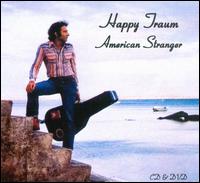
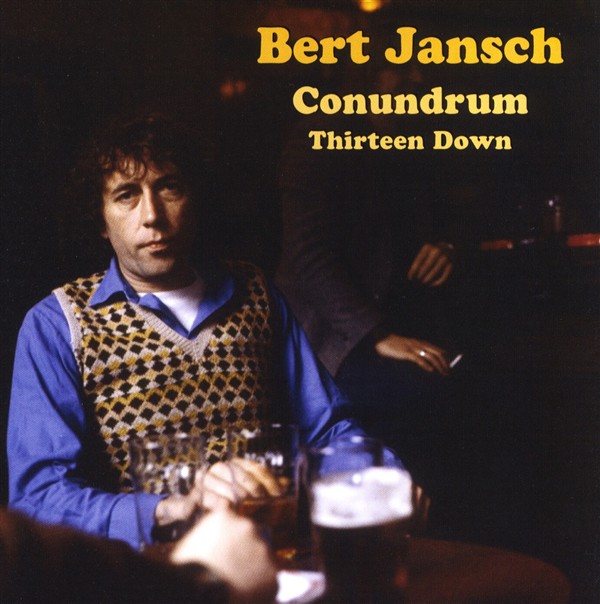
Happy_AmericanSGGW143This month, Stefan Grossman’s Guitar Workshop reissues two albums from the Kicking Mule Records catalog: Happy Traum’s American Stranger (1977) and The Bert Jansch Conundrum’s Thirteen Down (1979).  Happy Traum and Bert Jansch are each singer-guitarists who launched careers during the sixties folk revival in the States and Britain, respectively.  American Stranger and Thirteen Down provide glimpses of their work in the late seventies, an era when many folk singers were trying their luck at the introspective and potentially lucrative singer-songwriter market.  Both men share a sophisticated approach to the guitar that, for each, distinguishes a repertoire of songs.  Presumably, this is why both ended up releasing at least one record with Kicking Mule (a label specialized in guitar music), and also why I’ve opted to write about the reissues together.

In a BBC radio broadcast spotlighting Happy Traum, Grossman remarked:

“The sign of a truly great guitar player is not how complex he can play but, rather, that the sounds he produces are music… the forte of Happy Traum is that he can take a blues and arrange it in a rather simple fashion to produce a very lyrical and moving and very musical performance.”

The tunes on American Stranger bear out Grossman’s sentiments… clear and deliberate folk and blues guitar playing highlights the collection, and elevates Happy’s unaffected if somewhat plain-sounding vocal delivery.  A variety of contributors, including John Sebastian on harmonica, lend accompaniments throughout, subtly building on Traum’s performances. Continue reading

Interview : Maneli Jamal

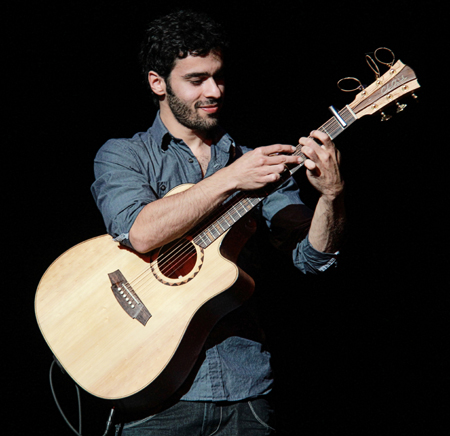
maneli-jamal_picManeli Jamal is a prodigious young fingerstylist, currently residing in Toronto, Canada. He works in the contemporary, highly physical two-hand style (lots of fretboard tapping with the picking hand) popular with a lot of young players these days, but there are several things that set Jamal apart from the multitudes of Andy McKee hopefuls who play the virtual YouTube circuit.

To say that Jamal’s technique is advanced would be a huge understatement. There aren’t many players in this style that have Jamal’s balance of power and sensitivity, nor his breadth of ideas. His rhythmic concepts can be alternately short and dense, or explored carefully through several movements, as in the four part suite from which The Ziur Movement album takes its name. Jamal has absorbed a number of musical styles, and he is able to seamlessly incorporate jazz, flamenco, classical and Persian ideas into his original compositions. The resulting pieces are very impressive, both technically and musically, and his CD is one of my favorites in the contemporary style.

I recently conducted this email interview with Jamal.

W&W : Let’s talk about the evolution of your fretting hand. You played in punk and metal bands when you were younger… would you say that that’s where you built up your strength and dexterity? Talk about your beginnings in guitar, and some of the early inroads you made toward your current (high) level of technique. Which players put you on the path to your current hybrid style?

When I started to play guitar I had already played violin for a few years learning from my father, a master Persian violinist. That definitely made learning the technical side of the guitar easier at first, especially the coordination between the hands. The great thing about punk and metal playing is that it’s fast and fun as hell to play for anyone starting the guitar.

Because I was self taught I used to be the kind of player that didn’t worry too much about accuracy but rather speed and what sounds cool, which was what punk music to me was all about. Unfortunately, I didn’t teach myself the discipline of accuracy and slow practice until years later. The guitarists of Thrice and Iron Maiden really influenced me in the punk / metal genre. I felt like I had reached a plateau after 3 years of playing that genre in my right hand picking. I thought the guitar pick was the best and most efficient way of playing the guitar… little did I know. I got into the likes of Al Dimeola and that opened up a whole new world for me. Continue reading

Review : Jameson Swanagon “Desolation Happiness” CD (Self Released, 2010)

Swanagon_Cover The ants were talking to us. They had been for weeks. If only we were even moderately fluent in Ant. They knew what was coming and they weren’t mucking about. Headed for the high ground – eggs in tow. Infiltrating our every potted plant on the upstairs balcony. A constant stream into the kitchen and straight for the pantry. Not a hint of aggression, this wasn’t an invasion, it was a purposeful and orderly relocation – essential. They were shouting at us. Louder than the goldfish shouts some mornings once it’s certain that we’ve forgotten that it’s well past piscean breakfast time. Not aggressive, but somewhat desperate. The juggling eggs of the worker ants were the formicidaic semaphore flags that we just weren’t reading. Then it rained. It rained constantly. The ground reached saturation point. It kept raining and there was no place for the water to go but downhill. Then the river slowly rose and the city flooded. Bull Sharks were spotted swimming down the freeway and as inundated houses were abandoned and disappeared below the brown tide many domesticated carp were, perhaps happily but involuntarily, reintroduced to the wild. My street being on high ground was spared, thankfully, and as I watched the city drown from my front yard I listened to a collection of music entitled Desolation Happiness by Jameson Swanagon. Continue reading