Tag Archives: Acoustic Guitar

Review : Tim Buckley “Live At The Folklore Center, NYC – March 6, 1967” CD (Tompkins Square, 2009)

Tim_Buckley_Liveby Raymond Morin

I first discovered Tim Buckley about ten years ago, when a band-mate played me the sublime Happy Sad album. It was something of a revelation, on par with The Zombies’ Odessey and Oracle, The Beach Boys’ Pet Sounds or Love’s Forever Changes… each of these records was able to penetrate my mistrust for classic rock and hippie-dippy affectations by offering up innovative production, unusual blends of acoustic and electric instruments, and acute musicality. Happy Sad had a vibe all its own, with David Friedman’s atmospheric washes of vibraphone and guitarist Lee Underwood’s jazzy, wandering leads… and then there was the singer, with his elastic, transcendent voice… I hadn’t heard anything like it before. I was hooked, and still remember making a point of telling everyone I knew about Tim Buckley. “Now that’s a singer!”

I was very excited when I found out that a new Buckley live document was in the offing, since his Dream Letter : Live In London 1968, Peel Sessions and subsequent Once I Was discs have always remained rewarding listens. Many fans prefer live Tim Buckley to the comparably inconsistent studio albums, including Tompkins Square label head Josh Rosenthal… and I knew that if Rosenthal was involved, Live At The Folklore Center – March 6, 1967 must be a significant recording. The story of how he came into the master tape is a fascinating one, and is recounted in detail in this Onion AV Club interview from a few weeks back. Tompkins Square is known for delivering impressive bang for the buck, and this package features rare archival photos and an unreleased interview with the singer. At 55 minutes, and featuring 6 never-released Buckley compositions, this important addition to his discography should be an easy sell for even casual fans.

…and an important recording it is. Live At The Folklore Center… captures a young Tim Buckley performing to a captive audience in an almost unbelievably intimate setting, the Folklore Center at 321 Sixth Ave in New York City. Attendance was between 30 and 40 people, and the recording was undertaken by Izzy Young, a dedicated NYC folk music enthusiast. The fidelity here is remarkably good, and though the “mix” is a little boomy guitar-wise, this proves a minor quibble. Everything about Tim Buckley, still in the formative stages of his short career, comes through loud and clear… including the fragile person behind the otherworldly voice.

Aside from the previously unreleased compositions, the songs are culled almost exclusively from Buckley’s first two studio albums, the date of the performance falling between the release of his self-titled debut and the recording of his second, Goodbye and Hello. The tracks that appeared on Tim Buckley tend to fare very well in the man-and-his-guitar context… From the outset, the setting appears casual enough, and Buckley nervously wonders whether the tape recorder will pick up his singing. Though this shy, nervous Buckley will reappear in stage banter throughout the set, he all but disappears in the opening chords of “Song For Janie”. With energetic strumming and sufficient guitar flourishes, the tune holds up well in this stripped-down setting.


Tim Buckley – “Song For Janie”
.
In “I Can’t See You”, Buckley wrestles with his guitar falling out of tune, but the song easily rises above some of Buckley’s other Elektra-era folk-pop by using an interesting verse structure and a dissonant, wordless chorus. “Aren’t You The Girl” has some of the most effective guitar accompaniment of the night, and even though the chord choices don’t vary greatly from the other songs, Buckley keeps it interesting by peppering his uptempo strumming with quick arpeggios and decending bass figures.

“Wings”, though, is unable to improve on the album version. The strumming feels heavy-handed, even when Buckley (briefly) attempts to soften the song’s dynamic toward the end of the track. The album’s string arrangement, saccharin as it was, had a way of nicely filling the spaces between the verses. The faster tempo of this version feels somewhat rushed.

The set performed on Live At The Folklore Center… isn’t perfectly paced or executed, far from it… the setlist is a long one, and there isn’t much variety in approach, technique or lyrical content on Buckley’s part. The songs that would soon appear on sophomore album Goodbye & Hello sound a little hollow here, bereft of their studio treatments. One gets the feeling that these were written in/for the studio, where the band and producers could run wild with the bubblegum-psych production embellishments that were coming into vogue at the time.
 In several cases, the lack of ear-candy lays bare the relatively flowery and ambiguous nature of Buckley’s lyrics. “Troubadour” features more than a few psych-pop clichés… “No Man Can Find The War” sits as awkwardly in this set as it does as the opener of Goodbye…, as Buckley, with no comment or introduction, waxes political on just one song of this sixteen song set. The lyrics fall all over themselves trying to paint a picture of the wartime conditions in the Vietnam jungle, and though I don’t miss the indulgent production of the studio version, this reading doesn’t really approach its ominous mood, keeping the song from resonating. “Phantasmagoria in Two” sounds like Buckley’s attempt at Tim Hardin’s “If I Was A Carpenter”, but lacks that song’s directness. It’s consistent with his writing from this period, the lyrical ambiguity making it hard to understand what Buckley is truely trying to say. That said, I do prefer this version to the studio take, which suffers from some unusually irritating noodling from Lee Underwood.

The forever young Tim Buckley

The forever young Tim Buckley

Two tracks from Goodbye… do work very well in this setting, equally important, but for much different reasons. In “I Never Asked To Be Your Mountain”, Buckley’s singing achieves a sublime balance of the personal and poetic. It’s a wonderful example of his vocal gift, the performance energetic and dynamic, Buckley’s excellent diction cutting perfectly through his almost violent guitar bashing… and I’ll always remember first hearing this version of “Carnival Song”, notable for the singer’s cracking voice at the end of the first verse, the only such mistake I’ve ever heard on a Tim Buckley recording. It is an amazing thing, and along with the occasionally out of tune guitar and Buckley’s aforementioned nervous demeanor throughout the set, shows the human side to Buckley’s usually larger-than-life voice and persona.


The unreleased tracks aren’t exactly lost classics, basically evoking the same moods and images as the other songs of the period. “What Do You Do (He Never Saw You)” closely echoes the vibe of “Phantasmagoria…” and features some very tender and beautiful singing, some of the most dynamic in the set. “Just Please Leave Me” has Buckley going for a heavy uptempo blues, but sounds a little more like The Monkees, while the similarly titled “I Can’t Leave You Loving Me” offers a preview of some of Buckley’s future bombastic jazz vocalizations, featuring a toned down version of the trademark falsetto-screams of his Starsailor and Lorca albums. “Country Boy” is also indicative of future artistic directions, showcasing the bluesy turns of Buckley’s late “Honeyman” (or as Wikipedia so elegantly puts it “Sex/Funk”) period. This album’s reading of the Fred Neil classic “Dolphins” not only falls far short of the sonic perfection to be found in Neil’s original, it also pales in comparison to Buckley’s later, full-band recordings of the tune.

Though it is almost impossible for this longtime fan to analyze Live At The Folklore Center, NYC… without regard to Buckley’s studio output, it is equally impossible to deny the sheer power of his voice in just about any context, and the near-naked presentation of the material on this album makes it a fascinating document. This record has given me a renewed appreciation for Buckley’s precise articulation, near-perfect vibrato, and ability to imbue his (and songwriting partner Larry Beckett’s) occasionally banal lyrics with sometimes subtle, sometimes explosive emotional energy. I would highly recommend this CD for fans of the L.A. and NYC-based folk music of the mid-60’s, and consider it an absolute must for Tim Buckley fans, especially those enamored of his early stylistic periods.

Buy this CD from Insound
Buy this CD from Tompkins Square

Raymond Morin / Pairdown September Tour Dates

J_Rose_Flier_93009

Work & Worry’s own Raymond Morin will be going out on the road at the end of September, touring in support of this year’s “Holykyle” LP by Pairdown. He’ll be playing songs from Pairdown, his solo work as The Instances, some new instrumentals and a few chestnuts from the British folk and blues revival. Morin will be joined by Micah Blue Smaldone on a couple of dates, as well as old friends Shrinking Islands and Quoins.

9/25 – Skylight 307 (w/ Shrinking Islands, Heirloom) 307 Market St (upstairs), Philadelphia PA… 7PM
9/26 – 421 Bigelow Hollow Rd (house show w/ old friends! Invite only!) Eastford, CT… 8PM
9/27 – The Apohadion (w/ Micah Blue Smaldone, Listo) 107 Hanover St, Portland ME… 8PM
9/28 – Zuzu (w/ Micah Blue Smaldone, Quoins) 474 Mass Ave, Cambridge MA… 9PM
9/29 – Pete’s Candy Store (w/ St. Cloud, Underscore Orkestra, Tori Sparks) 709 Lorimer, Brooklyn NYC… 8PM
9/30 – Morning Glory Coffee (Pairdown duo, w/ Jack Rose) 1806 Chislett St, Pittsburgh PA… 7:30PM

For more info or directions, please email sortofrecords at gmail dot com.

Check out Pairdown on Myspace
Buy Pairdown’s LP from Sort Of Records

Review : Ben Reynolds “How Day Earnt Its Night” CD (Tompkins Square, 2009)

Ben_Reynolds_How_Day_CoverBy Raymond Morin

Ben Reynolds is a member of the Scottish folk-rock band Trembling Bells, who are currently making a name for themselves on the European circuit. They’ve recently appeared at the yearly Green Man Festival, have a new record out on Honest Jon’s, and every press bit that I’ve seen has made mention of legendary producer Joe Boyd’s affection for the group. Not too shabby!

Mr. Reynolds busies himself with a great many projects, and has amassed a deep discography of noise and improvised recordings on such labels as Last Visible Dog, Strange Attractors Audio House, Beyond Repair, Dancing Wayang and others. The venerable Tompkins Square label tapped him for the third installment in their indispensable Imaginational Anthem compilation series, and this summer the label quietly released How Day Earnt Its Night, an instrumental acoustic guitar record and Reynold’s highest-profile solo outing to date.

Upon listening to the album and digging deeper into his back catalog, it’s clear that Reynolds has many interests, and that being associated with a a single style isn’t one of them. Thus, there is a little of everything on How Day Earnt Its Night… and though the recording quality is warm and clear, and Reynolds is a more than competent picker, there is a certain lack of direction that keeps many of these tracks from being home runs.

The songs generally fall into two categories : shorter, British Isles-flavored vignettes and extended Takoma-inspired explorations. Opener “Skylark (Scorner of the Ground)” takes the former approach, as Reynolds easily picks through some pleasant, stately figures. Though nothing revolutionary, the songs in this style are some of the best on the album, even if tracks like “Risen” and “England” rely more on the moods that they evoke than on any concrete melodic ideas. Reynolds builds most of these British-style songs around a simple alternating-bass with hammer-on riffs in the high strings, generally falling back on picking patterns and ignoring the harmonic possibilities in the chords’ middle voices. “Kirstie”, as lovely as it is, repeats the formula one last time, feeling a little like a song waiting for a singer.


Ben Reynolds – “Kirstie”
.
Most of the remaining tracks move in a decidedly more American (Primitive) direction, and the results are, sadly, a little underwhelming. “Death Sings” is bargain-basement Takoma, borrowing liberally from the vocabulary of John Fahey but adding nothing new to the conversation. “The Virgin Knows” is an over-long bottleneck dirge, piling on almost nine minutes of hammer-ons and meandering slide riffs, but never really going anywhere. Reynolds tries to channel Lightnin’ Hopkins on “All Gone Wrong Blues”, but the tune’s recycled blues runs and ever-present harmonica make for a pretty tedious listen.

Ben Reynolds

Ben Reynolds

The wild card on this collection is definitely the title track. “How Day Earnt Its Night” is the album’s centerpiece, sitting somewhat conspicuously between two of the aforementioned British-style tunes. “How Day…” opens with haunting three finger triplet-rolls on the high string, filling in over the course of the next few minutes with stark harmonics and staccato melodic fragments. The results are really pretty enchanting, reminding me of the hammer-dulcimer compositions of one of Reynolds’ soon-to-be-tourmates, Pittsburgh’s Mike Tamburo. Reynolds drops in some downtuned bass-note melodies, coloring the piece harmonically and adding more tension, before the still-blazing triplets are unceremoniously cut off around the eight-minute mark. The breakneck pace slows, and Reynolds noodles somewhat aimlessly for the remainder of the song… a disappointing anticlimax to what began as a very engaging and promising piece.


Ben Reynolds – “How Day Earnt Its Night” (excerpt)
.
I’ve got a few discs from Reynolds’ back catalog on their way, and am looking forward to seeing him live this autumn. While How The Day Earnt Its Night lacks originality, it does present Reynolds as a restless and intriguing picker, with both solid technique and an internalized knowledge of a few beloved acoustic guitar styles… and because Reynolds stands to grow exponentially as both a player and a composer, I plan to follow his progress closely.

Buy this CD from Insound
Buy this CD from Tompkins Square
Check out Ben Reynolds on Myspace

Review : Scott Witte “Sound Shadows” CD (Piggy Rooster Records, 2007)

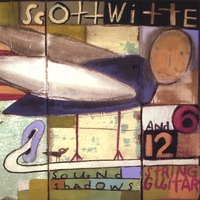
Scott Witte Sound Shadowsby Raymond Morin

When I first encountered last year’s Wayfaring Strangers – Guitar Soli compilation by the excellent Numero Group reissue label, I’ll admit that a lot of it blew right past me. The disc is a collection of music by some lesser-known guitarists who had cropped up in the era between the establishment of the watershed Takoma Records and Windham Hill labels, the recordings dating from the end of the 60’s to the dawn of the 80’s. The tracks, generally speaking, tow the line between highly physical Fahey/Kottke pattern-picking and the more heady, “New Age” atmospherics of the Windham Hill sound, without really charging headlong into either style.

Today, many pickers from Detroit’s Nick Schillace and Philly’s Jack Rose, to Israel’s Yair Yona are finding their audience by keeping the Takoma sound alive and well, boom-chicking their hearts out with the same spartan spirit and intensity as John Fahey in his heyday. In parallel, world-wide interest in atmospheric and impressionistic acoustic and electro-acoustic music has never been stronger, and a healthy lineage of avant-garde-leaning musicians from David Grubbs to Chris Brokaw to James Blackshaw to David Daniell have torn down and rebuilt “New Age” (now “Ambient”) guitar music for a new generation.

The players featured on Guitar Soli, in their day, were operating in a similar, albeit more isolated environment. Without today’s mass communication tools, like the luxury of instantaneous access to virtually any and all recorded music via the web, it would seem natural for these players to drift toward one end of the spectrum or the other, riding the respective tides of enthusiasm for more traditional or more contemporary musical ideas… but we’re talking about guitar players here. Great guitar players do what they want, when they want, regardless of the tastes and trends of their time… and that’s a beautiful thing. The world of music is not black and white, and much of the thrill of discovery, for musician and fan alike, comes from mining the rich territory in between established norms. This “in between” guitar music takes a little extra time, a little bit of attentive listening before it really starts to shine, and then it’s well worth the effort… so it is with many of the players on Guitar Soli, and so it is with Scott Witte.

Scott is a Milwaukee-born guitarist, currently residing in Washington state. Scott remains a relatively unknown quantity in the world of fingerstyle guitar. He’s bound to gain some purchase with “Sailor’s Dream”, his standout track on the aforementioned Numero Group compilation, an animated little tune which owes no small debt to the playing of Leo Kottke. Witte’s debut album, also titled Sailor’s Dream and originally released in 1980, is still pending reissue, but fans of six and twelve-string acoustic guitar music would do well to seek out Sound Shadows, his 2007 collection of originals. Recorded between 2002 and 2007, Scott’s sophomore album sees the guitarist composing and performing with astute passion and creativity, picking up where “Sailor’s Dream” left off, but with an appreciable evolution of technique, harmony and song structure.

The album starts off with “Song of the Crow”, and an eye-roll inducing sample of, you guessed it, a loud crow “KAW!” My first instinct : “How much effort would it take for me to manually edit that out of the MP3 version, so I never have to hear it again?” All is forgiven, though, when Scott launches into the song itself, which is a finger-picking tour-de-force, and a great introduction to the elements of his style. A forlorn, minor-key meditation snowballs into a gorgeous set of guitar patterns, effortlessly moving back and forth between conventional and odd time signatures. It’s quite a trip, and sets the bar very high for the rest of the record.


Scott Witte – “Song of the Crow”
.
“Time Enough” features some percussive fret-board whacking which segways into a 70’s-rock inspired strumming section. “Bounce” should appeal to fans of uplifting, major key picking motifs. “Sweet Reminisce” and “Land of the Setting Sun” are slow, minor-key dirges, and “Land…” contains some interesting techniques that you don’t hear very often, such as fretting the high string on the side of the neck to create high-pitched hammer-on effects, a la Davy Graham. The interwoven strumming, mournful basslines and unexpected chord changes also put me in mind of Peter Finger’s classic “Wishbone Ash”.

“One Last Time” is all joy and effervescence, the buoyant chord clusters being played in an unusual 7/8 pattern. It’s a real showcase for Mr. Witte’s clean right hand technique, but it also illustrates how he transcends the American Primitive style by thinking about the voice of the entire chord, rather than droning two or three notes and throwing down a simple repeating melody over the top.


Scott Witte – “One Last Time”
.
At this point in an album, and with so much ground covered, one might start to worry about the well of ideas beginning to run dry… but Scott is just hitting his stride. Sound Shadows reaches it’s creative apex with “Inward Journey”, a composition that cycles through many movements, each more striking than the last. Much like James Blackshaw, one of the better-known modern-day purveyors of the long-form acoustic guitar song, Scott deftly picks his way through some gorgeous groups of chords, alternately accentuating notes in every register. That Mr. Witte is a virtuoso shouldn’t be a mystery to anyone at this point, bouncing back and forth between finger-rolls, time signatures and melodic snippets with the greatest of ease.

Genre-blurring acoustic guitarist Scott Witte

Genre-blurring acoustic guitarist Scott Witte

The album begins to wind down with “Walking On Air”, which revisits the sad, dirge-y mood of some of the earlier tunes. A short poem, “One Day Came a Crow”, reminds us of the loose concept of the album before closer “Prayer For Peace”, a very pretty pattern-picking invention in 5/8.

Though the few quirky “New Age” devices/trappings (the crow theme, the spoken word, etc.) at times threaten to cheese-up the proceedings (I know, right? Such a literate review and the best I could come up with was “cheese-up”), they prove minor distractions, relatively benign in the greater scheme of things. Sound Shadows is a serious, and seriously accomplished guitar album. The recording quality is very good indeed, the 12-string numbers featuring nice, thick close-micing, while the 6-string compositions benefit from the added sparkle of a little electric pickup mixed in. It is no small accomplishment that this group of songs, recorded intermittently over a five year period, are so of-a-piece… this collection could be sequenced any number of ways and would be no worse for the wear, a testament to Scott’s ability to keep things consistently varied and exciting. Though Scott Witte has been off the radar for some 28 years, with Sound Shadows he proves that he is not only in step with the current acoustic guitar scene, he also has the potential to be one of its leading lights.

Buy this CD from CD Baby
Check out Scott’s website

Interview : Denis Turbide

Denis Turbide, playing a Larrivée 00-50

Denis Turbide, playing a Larrivée 00-50

Over the last couple of weeks, I’ve gotten to know Denis Turbide, a very fine fingerstyle guitarist from up Canada way. Denis has a self-titled, self-released CD out now… you can read the Work & Worry review here. The man also obliged W&W with a nice interview, presented below.

W&W : How old were you when you started playing guitar?

Denis : I was 13 years old when my parents got me a classical guitar for Christmas, and I took lessons for a few months after that.

W&W : When did your interest in fingerstyle guitar develop?  Please talk about your early influences…  what moved you to work in the style?

Denis : There was always fingerstyle, right from the start.  It was a classical guitar my parents had given me, after all.  My dad was a classical/opera guy.  He sang on French-Canadian radio and early TV with choirs when he was younger.  He wanted me to play classical guitar.

My first teacher taught me Beatles and Supertramp…the pentatonic scale.  I had a classical teacher after that first summer but I didn’t like reading music.  At the same time, I was listening to, and trying to learn, a lot of Simon and Garfunkel, Cat Stevens, Beatles, Led Zeppelin, James Taylor, Neil Young, America… obviously anything acoustic.  Jimmy Page’s acoustic playing is still some of my favourite music.

W&W : Did your dad enjoy the rock and pop music that you were getting into?  Could he appreciate the stuff you were working to learn?

Denis : Dad was a real Bach, Beethoven, Vivaldi, Rossini, Leoncavallo kinda guy.  Glenn Gould, Yehudi Menhuin, Mario Lanza, Pavarotti, Beverly Sills, Maria Callas…  Pop [music], when he was young, was Elvis and Chuck Berry, but Dad didn’t dig it too much.  Classical music did rub off on me, though.  I love hearing Bach especially.  Some of the most incredible and powerful music ever written.   All that said, I’m sure he could sing a few Beatles tunes…

W&W : So you gave up on the lessons pretty early on, and decided to follow your ear?  How long was it before you switched over to steel strings?

Denis : The lessons I did for about 8-9 months altogether, over the course of about a year and a half.  I learned fast and nobody ever had to force me to practice.  I knew a lot of chords, found changes and learned new songs all the time. The next guitar I got after 2 years with the classical was a 12-string.  I guess I didn’t play much fingerstyle on it, but I’m sure I played some… we’re talking some 25+ years ago.

W&W : Have you always flown solo, or did you spend any time playing in groups?

I wasn’t ever really in a group.  There was a duet for while, over a decade ago, but since then it’s been pretty much me.

W&W : What tunings do you use on your recent s/t CD?

Denis : “A Little Bit” is in standard, “Derivatives” is dropped D, “After the Battle” is in DGDGBbD (open G min) and then DADGAD for “Samuel”, “Havre-aux-maisons” and “Firstborn”.  My new tune, “That Face”, is in open G or DGDGBD.

W&W : You have a lot of YouTube hits and a lot of people requesting TABs for your songs…  it has obviously been very good exposure for you, but how do you feel about the internet and social networking sites (Myspace, etc) and how it relates to the essence of playing guitar?  Do you think it’s a natural progression from learning about guitar through books, concerts and albums?

Denis : How it relates to the essence of playing the guitar?  Natural progression?  Not sure about that but it’s been helpful getting the music out there, [though] obviously it does take up a lot of time getting things together.  There are so many different sites now as well.  How does anyone choose the one(s) that will get the most exposure?  They all want you to join their site and all of them say that they will get you noticed….blah, blah, blah.

It is fun being an indie artist, though.  Everything I’ve acheived so far is all because of the effort I put into it.  The fact that people actually ask for my tabs is still a bit mindblowing for me, though.  Sure, I’d love for more people to hear my music and to love it, but the fact that some out there want to actually learn my stuff is pretty exciting.

W&W : What was the process of getting the TABs together?

Denis : I checked around online looking for someone who tabs out tunes as it would have taken me a long time to do it.  Writing out a few bars on some tab paper with a pencil and doing a whole tune on a computer are two different things.  Alois Kleewein checked out the tunes… he really liked “Samuel”. He sent me some Tabledit previews, then he ran them through some software he’s got.  They came out pretty nice.  He plays in a funk band in Austria and we’ve only ever communicated online.

W&W : Talk a little bit about the guitars you’re using, string gauges, fingerpicks or no?  Do you use the ring finger when you pick, thumb and two fingers, no particular approach?

Denis : I’ve been playing Larrivées for the last few years.  Great guitars.  Late last year, some members of the Larrivée online forum came up with some specs for a custom model that I was really interested in.  It’s a smaller version of their proprietary L model, an LS, but they made it with a 12 fret neck, which I love.  Mine has an Italian spruce top and mahogany back and sides.  Outstanding.

Denis' Limited-Production Larrivée LS

Denis' Limited-Production Larrivée LS

For the CD, I used an L-03R and OO-50, both Larrivées and both I no longer own.  The new LS I used for [the new recording] “That Face”. Uncoated D’Addarios are pretty much what I use when it comes to strings.  The plain old EJ16, phosphor bronze light gauge. Their quality is consistent, they’re cheap and everyone has them in stock pretty much all the time.  I’ve never been able to use finger/thumbpicks.  I use a combination of flesh and nail when it comes to the picking, and I do use the ring finger as well.  When I used to teach, I would tell the students to use the ring finger for the first string, middle for the second, index for the third and the thumb was for the top three.  But then, no rule is written in stone.

W&W : Earlier this year, you talked about pursuing gigs again, after a pretty good hiatus…  how has that been going?  Do you see any touring in your future to promote this or future releases?  Any upcoming gigs to report?

Denis : I would love to tour and stuff but I’ve got shared custody of my 3 and 6 year old sons, a full-time job, a mortgage… responsibilities.  I’m not 20 anymore either!  I should be more proactive, more aggressive but I’ve got so much going as it is.  I’d love for this to become a career but, as everyone knows, the music business isn’t exactly a steady job with a regular paycheck.  I have a regular monthly gig in Ottawa, Ontario at a pub called Woody’s.  Great place.  I started playing the open mic on Mondays about 2 years ago.  It’s a relaxed, no pressure kind of place.

No future releases in the works right now but that could change if I come up with something new.

W&W : What cover songs are in your current repertoire?  Which songs, cover versions or originals, do you find the most challenging to play? 

Denis : My repertoire includes just about anything I can remember!  I’ve been learning songs and pieces for nearly 30 years so there’s a lot that I forget I know how to play.  Some of my favourites are up on YouTube now… “Little Martha”, “Never Going Back”, “That’s the Way”, and “Take Five”.  I do a fingerstyle/vocal version of “Whiter Shade of Pale”, “Fragile” by Sting… I’m a big Beatles fan, so I do a bunch of their tunes like “Blackbird”, “Norwegian Wood”, and “You’ve Got To Hide Your Love Away”.  I do a couple of [Pierre] Bensusan tunes, John Renbourn’s  “Luke’s Little Summer”… that’s one of my all-time favourite pieces on the guitar.

W&W : Your picking style seems to have a healthy dose of American Primitive influence (Kottke, Fahey, Takoma Recs… steady boom-chick with melodies in the high strings, etc..)  Would you say that that was an important influence, and have you kept an eye on the current crop of American Primitive-style players?

Denis : Well, I started learning the alternating bass thing way back with tunes like “The Boxer” and “Dust in the Wind”… still play those live too!  But Leo Kottke, Fahey… amazing players.  I don’t really play any Kottke tunes but there are some that I love… anything off of 6 and 12 String Guitar… wow, what a great album!!  Jerry Reed’s “Heavy Necking” book… great stuff for any picker in there!  I’m not really familiar with much new music/players these days.  It appeals to me but I just can’t seem to find the time to really listen and enjoy.  I barely have time to sit and play myself!

W&W : Your children seem to be one of your biggest inspirations.  Do you think your children might follow your lead and become players?

Denis : My kids are my life.  I’ll love them no matter what.  I’m not sure if they’ll ever want to play, let alone want to play with the old man!  I just want them to be happy with whatever they choose to do.  That’s all any parent can hope for.

Interview by Raymond Morin

Buy Denis’ CD from CD Baby
Check out Denis on Myspace