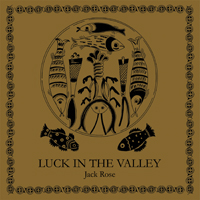
Performing is a musician’s most reliable path to the mastery of technique and ideas. The late Jack Rose constructed his solo guitar repertoire through years of persistent touring to become one of the commanding players of our generation. His 2005 album, Kensington Blues, presented eight selections that would serve as prototypes for his subsequent work, and a guitar vocabulary that was both deep-rooted and deliberately limited. Jack did not dabble, at least in public (he once told me that he played “Blackwaterside” now and then for a kick or as a warm-up). Instead, he continually explored variations of his core ideas. On his ultimate album, Luck In The Valley, he works primarily in ensemble with a cast that includes Glenn Jones, The Black Twig Pickers, Harmonica Dan and Hans Chew.
Jack’s work on the Weissenborn is the part of his repertoire I enjoy most. He used lap slide conventionally, for blues solos, but would also turn to it for modal, rāga-like excursions like “Now That I’m A Man Full Grown II” (from Kensington Blues) and “Song For The Owl” (from the limited edition 2009 LP, The Black Dirt Sessions). Luck In The Valley opens with a selection in this mold, entitled “Blues For Percy Danforth.” Jack’s slide on the take is charged and immediate, while an accompaniment of jaw harp and harmonica cleverly approximates sitar overtones. Within the context of the current guitar underground, where there is no shortage of Hindustani exotica, this cut strikes me as a revelation:
As “Danforth” fades, the album turns on a dime into “Lick Mountain Ramble,” the first of several rowdy ensemble pieces described in the press notes as “three-track shack recordings.” These tunes are elemental, joyful and beautifully presented. Jack’s “boom-chick” is the pervasive force, but is never artificially favored in the mixes, which are appropriately roomy and not over-engineered. My favorite is “When Tailgate Drops, The Bullshit Stops” (of course, though, I’m a sucker for the title)
“Tree In The Valley,” from the latter half of the album, is the second rāga-style work and one of only two solos, played in the manner of Robbie Bãsho’s “A North American Raga (The Plumstar)” (from 1971’s Song Of The Stallion LP) and Jack’s own “Cross the North Fork” (originally from Kensington Blues, with alternate takes on Tompkins Square’s Imaginational Anthem Volume 2 compilation of 2006 and also The Black Dirt Sessions). What I think Rose brings to this type of guitar playing that most others have not is an unwavering sense of resolve: there is never a moment’s hesitation, never a loss of direction. He also brings near-flawless execution, and so absent are the missed and bum notes that could jar the listener from reverie.
While Kensington Blues will likely endure as Jack’s signature work, Luck In The Valley, his best since, is a worthy, multifaceted companion.
Alasdair Roberts has earned his reputation as a respectful interpreter, having adopted and re-imagined many well-known British Isles ballads (see his excellent “Lord Ronald”, from 2005’s No Earthly Man). The Scottish singer/guitarist has deep roots in traditional music, but in the US, he is equally associated with modern indie-rock. Roberts has toured and recorded with many top performers from both worlds, and his own music is something of a hybrid, a blending of those sensibilities. He usually sings in a taut yet gentle tenor, not unlike that of American contemporary and label-mate Will Oldham (Palace, Bonnie Prince Billy). While Roberts and Oldham share certain undeniable similarities in cadence and timbre, it would be a good idea to end the comparisons there… Roberts is on his own path, and through his long association with the Drag City label, has built one of the most consistently satisfying catalogs in indie-folk. The trend continues with The Wyrd Meme, a mini-album that follows on the heels of this year’s full-length Spoils.
This four song set possesses all the hallmarks of the singer’s unique style: flowery, borderline archaic language, traditional or traditional-derived melodies, varied and refreshing arrangements, and clever turns of phrase never in short supply. On opener “The Hallucinator and the King of the Silver Ship of Time”, Roberts paints a detailed portrait of the curious Hallucinator, and her visit from the King of Time, at the bottom of the ocean. Both the narrator’s point of view and the purpose of the meeting are nebulous, yet the imagery is so vivid that it’s hard not to get drawn in.
While that fantastical setting of “Hallucinator…” sounds something akin to a fable, second track “The Yarn Unraveller” seems to describe an imminent separation of the common human variety, one person leaving on a journey while the other is left behind. The song finds precedent in the Child Ballad “The Trooper and the Maid”, which has a similar premise and melodic arc, but as with many of Roberts’ re-castings, there is an appreciable immediacy and warmth that keeps things from sounding dated.
Alasdair Roberts – “The Yarn Unraveller”
Though the collection has it’s share of achingly sad and beautiful moments, there is also a welcome thread of levity woven into the songs. Closer “Coral and Tar” takes the form of a lullaby, and contains some real gems of wordplay, as Roberts mixes up self-deprecating humor, modern asides and naturalistic themes. Alliteration-rich lines such as “I’m no pine, I’m a man in my prime and I’m pining” and the twisting “…to join with the pine and to join with the oak in their blood oath to choke up the garden” are classic Roberts… seemingly world-weary, but with a wink.
The Wyrd Meme is a short yet worthy addition to Alasdair Roberts’ healthy discography. Existing fans won’t find any real surprises, but they will most certainly not be disappointed, and for the uninitiated, Meme would be a fine starting point.
In the avant-rock band Cul de Sac, guitarist Glenn Jones and his bandmates combine fingerstyle electric guitar, krautrock rhythms and harsh electronics, creating a challenging, textured sound that defies categorization. In 1997, the group famously collaborated with acoustic guitar icon John Fahey and released the album The Epiphany of Glenn Jones. Now, over a decade later, comes the third solo outing from Jones, and on Barbecue Bob in Fishtown the spirit of John Fahey and his American Primitive approach is alive and well.
Though his band is known for their experimental leanings, Glenn Jones the solo artist is considered something of a traditionalist, and the Barbecue Bob… package is very much presented in the grand tradition of instrumental acoustic guitar collections of years past. From the light-hearted cover image and the eloquent, self-penned liner notes to the tuning references and instrument notes for each song, the art direction has a classic feel… the album could pass as an artifact from any point in the last 40 years. When the included booklet is flipped over and reversed, we’re treated to a photo-diary of Jones paying a visit to Belmont Nails, for what appears to be an application of fresh acrylics. All of this is the kind of stuff that guitar geeks eat up, myself included!
Well, as everyone knows, the best compliment to great packaging is great music (to listen to while staring at the great packaging, of course!) and on Barbecue Bob in Fishtown, Jones delivers some fine picking indeed. The album kicks off with the upbeat alternating bass of the title track, the bends and rolls evoking both Fahey and some of the modern purveyors of his style, such as Nick Schillace and Jack Rose. Jones’ style immediately stands apart from those players in its more relaxed attack, never quite approaching the tidiness of Schillace or the determined physicality of Rose. I find the easy, slightly ragged character of Jones’ picking to be very charming, particularly on “Barbecue Bob…”, “Dead Reckoning” and album closer “A Geranium For Mano-a-Mano”.
(MP3 Returning Soon) Glenn Jones – “A Geranium For Mano-a-Mano”
There are two brief banjo pieces on the album, and both are compelling listens. Mood and tempo-wise, “Keep It A Hundred Years” and “A Lark In Earnest” are very similar, a possible product of Jones’ relative newness to the instrument… but in spite of this, his knack for composition wins out, and the banjo songs stand up as some of the most melodically driven on the album. “Keep It…” contains some unexpected chord changes, keeping it interesting and unpredictable, while “Lark…” benefits from a simple, memorable melodic theme and some very nice finger-rolls.
Glenn Jones in action
“1337 Shattuck Avenue, Apartment D”, Jones’ tribute to Robbie Basho, is one of the most emotive tracks on the disc, and also its longest. In the liner notes, Jones explains that this loosely structured composition was one of many takes, and was chosen for its “uncertain” feel. There is definitely a palpable degree of uncertainty in the playing, with many of the notes fretting out around the 4 1/2-minute mark as Jones begins descending into dark, dissonant territory. Still, the emotional thread that runs through the song, coupled with the variety of the sections, keeps the listener wholly invested.
My favorite song on the album is “For Wendy, In Her Girlish Days”. This selection contains some of Jones’ most delicate and beautiful playing, and its primary theme is a nice hybrid of Leo Kottke-style alternating bass and chord voicings, supporting a vaguely British-tinged melodic approach.
(MP3 Returning Soon) Glenn Jones – “For Wenday In Her Girlish Days”
Glenn Jones is something of a staple in the current solo acoustic guitar movement, and Barbecue Bob in Fishtown makes a great case for why that is. Jones’ playing shows him to be a guitarist with a distinctive touch, an experienced player with a pleasing affection for traditional picking as well as a flare for varied and innovative composition.
Constancy is one of the charms of the solo fingerstyle guitar category. In contrast to the rip-it-up-start-again ethos of musicians from various other genres, the notable fingerstyle guitarists have openly emulated earlier players while carefully making their own mark. Nonetheless, the category transforms, with resonant changes occurring when a particular player can effectively bring unique attitudes of his/her time to the story. So it was with British fingerstyle guitarist Dave Evans, his classic Kicking Mule album from 1974, Sad Pig Dance, re-issued this fall as an expanded CD collection by Stefan Grossman’s Guitar Workshop.
At the outset of the 1970’s, Dave released The Words In Between and Elephantasia, both solid examples of singer-songwriter music from the period, with a few instrumental numbers added to the mix. “Ten Ton Tasha” and “Elephantasia,” from the latter, both feature whimsical, delay-treated overdubs sounding akin to progressive rock music, which was in its heyday at the time. I asked Stefan Grossman — producer of the Sad Pig Dance sessions, co-founder of Kicking Mule Records and tireless champion of Dave’s guitar playing — about the shift in emphasis from songs and multi-layered arrangements to unaccompanied guitar:
“Kicking Mule Records featured guitar solos and Dave had quite a few solo instrumentals he wanted to record. He and I wanted to present these as solos as the tunes were so interesting and did not need any other instruments to clutter up the melodies”
The incredible opening cut from Sad Pig Dance, “Stagefright” is one of Dave’s signature works. Aptly described by Grossman as a “tour de force in guitar playing,” it shifts through an array of moods in a short time (under four minutes). The introductory passage, a playful assemblage of hammer-ons and pull-offs, ushers in the Celtic-tinged verse, which is gradually subverted by increasingly chaotic runs before giving way to the triumphant, strummed passage and repeating in full. The performance of “Stagefright” featured on the Vestapol DVD Fingerstyle Guitar: New Dimensions & Explorations 2, is one of the most charismatic pieces of solo guitar footage I’ve seen:
My favorite cut from the album is “Morocco John.” This tune has an emotional, sketch-like quality that I find very moving. In the notes from the LP sleeve, Dave describes it thus:
“For John who rented a beautiful house overlooking the Atlantic for three pounds a month. I spent a week with him, living on chick pea soup, brown bread and olives. He taught me to play…”
Herein is another charm of the solo fingerstyle guitar (or any instrumental) category… its narrative power. As with “Morocco John,” a hint from the composer, embedded within the title or liner notes, can move the listener to imagine the narrative as the tune unfolds.
An excerpt from “Morocco John” by Dave Evans
In 1976, Kicking Mule released the follow-up to Sad Pig Dance, a mix of songs and instrumentals entitled Take a Bite out of Life. Stefan Grossman, who again served as producer for the sessions, recalls:
“When we came to the second album of his songs we tried to get other companies interested that focus on singer/songwriters as Kicking Mule certainly did not. But no other record company was interested so we decided to try our best on KM.”
As with Dave’s first recordings, there are some fine songs on Take a Bite out of Life. Still, its standout cuts are the four instrumentals (all of which appear as bonus tracks on the Sad Pig Dance CD reissue). I’m not sure it would be fair to characterize Dave as “the gifted guitarist who was compelled to sing,” though one might conclude it from studying the arc of his recording career, which effectively ended in the late 1970’s (Dave now lives as a potter in Belgium). Either way, in my mind, he was one of the rare players whose command of traditional material was virtually unmatched, yet also possessed the flair and imagination to weave elements of his time into the music, leaving the tradition richer.
I first discovered Tim Buckley about ten years ago, when a band-mate played me the sublime Happy Sad album. It was something of a revelation, on par with The Zombies’ Odessey and Oracle, The Beach Boys’ Pet Sounds or Love’s Forever Changes… each of these records was able to penetrate my mistrust for classic rock and hippie-dippy affectations by offering up innovative production, unusual blends of acoustic and electric instruments, and acute musicality. Happy Sad had a vibe all its own, with David Friedman’s atmospheric washes of vibraphone and guitarist Lee Underwood’s jazzy, wandering leads… and then there was the singer, with his elastic, transcendent voice… I hadn’t heard anything like it before. I was hooked, and still remember making a point of telling everyone I knew about Tim Buckley. “Now that’s a singer!”
I was very excited when I found out that a new Buckley live document was in the offing, since his Dream Letter : Live In London 1968, Peel Sessions and subsequent Once I Was discs have always remained rewarding listens. Many fans prefer live Tim Buckley to the comparably inconsistent studio albums, including Tompkins Square label head Josh Rosenthal… and I knew that if Rosenthal was involved, Live At The Folklore Center – March 6, 1967 must be a significant recording. The story of how he came into the master tape is a fascinating one, and is recounted in detail in this Onion AV Club interview from a few weeks back. Tompkins Square is known for delivering impressive bang for the buck, and this package features rare archival photos and an unreleased interview with the singer. At 55 minutes, and featuring 6 never-released Buckley compositions, this important addition to his discography should be an easy sell for even casual fans.
…and an important recording it is. Live At The Folklore Center… captures a young Tim Buckley performing to a captive audience in an almost unbelievably intimate setting, the Folklore Center at 321 Sixth Ave in New York City. Attendance was between 30 and 40 people, and the recording was undertaken by Izzy Young, a dedicated NYC folk music enthusiast. The fidelity here is remarkably good, and though the “mix” is a little boomy guitar-wise, this proves a minor quibble. Everything about Tim Buckley, still in the formative stages of his short career, comes through loud and clear… including the fragile person behind the otherworldly voice.
Aside from the previously unreleased compositions, the songs are culled almost exclusively from Buckley’s first two studio albums, the date of the performance falling between the release of his self-titled debut and the recording of his second, Goodbye and Hello. The tracks that appeared on Tim Buckley tend to fare very well in the man-and-his-guitar context… From the outset, the setting appears casual enough, and Buckley nervously wonders whether the tape recorder will pick up his singing. Though this shy, nervous Buckley will reappear in stage banter throughout the set, he all but disappears in the opening chords of “Song For Janie”. With energetic strumming and sufficient guitar flourishes, the tune holds up well in this stripped-down setting.
Tim Buckley – “Song For Janie” .
In “I Can’t See You”, Buckley wrestles with his guitar falling out of tune, but the song easily rises above some of Buckley’s other Elektra-era folk-pop by using an interesting verse structure and a dissonant, wordless chorus. “Aren’t You The Girl” has some of the most effective guitar accompaniment of the night, and even though the chord choices don’t vary greatly from the other songs, Buckley keeps it interesting by peppering his uptempo strumming with quick arpeggios and decending bass figures.
“Wings”, though, is unable to improve on the album version. The strumming feels heavy-handed, even when Buckley (briefly) attempts to soften the song’s dynamic toward the end of the track. The album’s string arrangement, saccharin as it was, had a way of nicely filling the spaces between the verses. The faster tempo of this version feels somewhat rushed.
The set performed on Live At The Folklore Center… isn’t perfectly paced or executed, far from it… the setlist is a long one, and there isn’t much variety in approach, technique or lyrical content on Buckley’s part. The songs that would soon appear on sophomore album Goodbye & Hello sound a little hollow here, bereft of their studio treatments. One gets the feeling that these were written in/for the studio, where the band and producers could run wild with the bubblegum-psych production embellishments that were coming into vogue at the time. In several cases, the lack of ear-candy lays bare the relatively flowery and ambiguous nature of Buckley’s lyrics. “Troubadour” features more than a few psych-pop clichés… “No Man Can Find The War” sits as awkwardly in this set as it does as the opener of Goodbye…, as Buckley, with no comment or introduction, waxes political on just one song of this sixteen song set. The lyrics fall all over themselves trying to paint a picture of the wartime conditions in the Vietnam jungle, and though I don’t miss the indulgent production of the studio version, this reading doesn’t really approach its ominous mood, keeping the song from resonating. “Phantasmagoria in Two” sounds like Buckley’s attempt at Tim Hardin’s“If I Was A Carpenter”, but lacks that song’s directness. It’s consistent with his writing from this period, the lyrical ambiguity making it hard to understand what Buckley is truely trying to say. That said, I do prefer this version to the studio take, which suffers from some unusually irritating noodling from Lee Underwood.
The forever young Tim Buckley
Two tracks from Goodbye… do work very well in this setting, equally important, but for much different reasons. In “I Never Asked To Be Your Mountain”, Buckley’s singing achieves a sublime balance of the personal and poetic. It’s a wonderful example of his vocal gift, the performance energetic and dynamic, Buckley’s excellent diction cutting perfectly through his almost violent guitar bashing… and I’ll always remember first hearing this version of “Carnival Song”, notable for the singer’s cracking voice at the end of the first verse, the only such mistake I’ve ever heard on a Tim Buckley recording. It is an amazing thing, and along with the occasionally out of tune guitar and Buckley’s aforementioned nervous demeanor throughout the set, shows the human side to Buckley’s usually larger-than-life voice and persona.
The unreleased tracks aren’t exactly lost classics, basically evoking the same moods and images as the other songs of the period. “What Do You Do (He Never Saw You)” closely echoes the vibe of “Phantasmagoria…” and features some very tender and beautiful singing, some of the most dynamic in the set. “Just Please Leave Me” has Buckley going for a heavy uptempo blues, but sounds a little more like The Monkees, while the similarly titled “I Can’t Leave You Loving Me” offers a preview of some of Buckley’s future bombastic jazz vocalizations, featuring a toned down version of the trademark falsetto-screams of his Starsailor and Lorca albums. “Country Boy” is also indicative of future artistic directions, showcasing the bluesy turns of Buckley’s late “Honeyman” (or as Wikipedia so elegantly puts it “Sex/Funk”) period. This album’s reading of the Fred Neil classic “Dolphins” not only falls far short of the sonic perfection to be found in Neil’s original, it also pales in comparison to Buckley’s later, full-band recordings of the tune.
Though it is almost impossible for this longtime fan to analyze Live At The Folklore Center, NYC… without regard to Buckley’s studio output, it is equally impossible to deny the sheer power of his voice in just about any context, and the near-naked presentation of the material on this album makes it a fascinating document. This record has given me a renewed appreciation for Buckley’s precise articulation, near-perfect vibrato, and ability to imbue his (and songwriting partner Larry Beckett’s) occasionally banal lyrics with sometimes subtle, sometimes explosive emotional energy. I would highly recommend this CD for fans of the L.A. and NYC-based folk music of the mid-60’s, and consider it an absolute must for Tim Buckley fans, especially those enamored of his early stylistic periods.
 by David Leicht


 WORK & WORRY