
Category Archives: Reviews

Review : Ben Reynolds “How Day Earnt Its Night” CD (Tompkins Square, 2009)

Ben_Reynolds_How_Day_CoverBy Raymond Morin

Ben Reynolds is a member of the Scottish folk-rock band Trembling Bells, who are currently making a name for themselves on the European circuit. They’ve recently appeared at the yearly Green Man Festival, have a new record out on Honest Jon’s, and every press bit that I’ve seen has made mention of legendary producer Joe Boyd’s affection for the group. Not too shabby!

Mr. Reynolds busies himself with a great many projects, and has amassed a deep discography of noise and improvised recordings on such labels as Last Visible Dog, Strange Attractors Audio House, Beyond Repair, Dancing Wayang and others. The venerable Tompkins Square label tapped him for the third installment in their indispensable Imaginational Anthem compilation series, and this summer the label quietly released How Day Earnt Its Night, an instrumental acoustic guitar record and Reynold’s highest-profile solo outing to date.

Upon listening to the album and digging deeper into his back catalog, it’s clear that Reynolds has many interests, and that being associated with a a single style isn’t one of them. Thus, there is a little of everything on How Day Earnt Its Night… and though the recording quality is warm and clear, and Reynolds is a more than competent picker, there is a certain lack of direction that keeps many of these tracks from being home runs.

The songs generally fall into two categories : shorter, British Isles-flavored vignettes and extended Takoma-inspired explorations. Opener “Skylark (Scorner of the Ground)” takes the former approach, as Reynolds easily picks through some pleasant, stately figures. Though nothing revolutionary, the songs in this style are some of the best on the album, even if tracks like “Risen” and “England” rely more on the moods that they evoke than on any concrete melodic ideas. Reynolds builds most of these British-style songs around a simple alternating-bass with hammer-on riffs in the high strings, generally falling back on picking patterns and ignoring the harmonic possibilities in the chords’ middle voices. “Kirstie”, as lovely as it is, repeats the formula one last time, feeling a little like a song waiting for a singer.


Ben Reynolds – “Kirstie”
.
Most of the remaining tracks move in a decidedly more American (Primitive) direction, and the results are, sadly, a little underwhelming. “Death Sings” is bargain-basement Takoma, borrowing liberally from the vocabulary of John Fahey but adding nothing new to the conversation. “The Virgin Knows” is an over-long bottleneck dirge, piling on almost nine minutes of hammer-ons and meandering slide riffs, but never really going anywhere. Reynolds tries to channel Lightnin’ Hopkins on “All Gone Wrong Blues”, but the tune’s recycled blues runs and ever-present harmonica make for a pretty tedious listen.
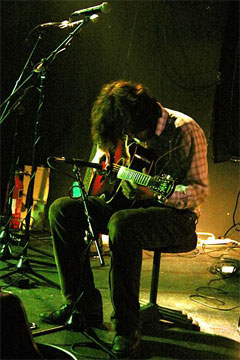
Ben Reynolds

Ben Reynolds

The wild card on this collection is definitely the title track. “How Day Earnt Its Night” is the album’s centerpiece, sitting somewhat conspicuously between two of the aforementioned British-style tunes. “How Day…” opens with haunting three finger triplet-rolls on the high string, filling in over the course of the next few minutes with stark harmonics and staccato melodic fragments. The results are really pretty enchanting, reminding me of the hammer-dulcimer compositions of one of Reynolds’ soon-to-be-tourmates, Pittsburgh’s Mike Tamburo. Reynolds drops in some downtuned bass-note melodies, coloring the piece harmonically and adding more tension, before the still-blazing triplets are unceremoniously cut off around the eight-minute mark. The breakneck pace slows, and Reynolds noodles somewhat aimlessly for the remainder of the song… a disappointing anticlimax to what began as a very engaging and promising piece.


Ben Reynolds – “How Day Earnt Its Night” (excerpt)
.
I’ve got a few discs from Reynolds’ back catalog on their way, and am looking forward to seeing him live this autumn. While How The Day Earnt Its Night lacks originality, it does present Reynolds as a restless and intriguing picker, with both solid technique and an internalized knowledge of a few beloved acoustic guitar styles… and because Reynolds stands to grow exponentially as both a player and a composer, I plan to follow his progress closely.

Buy this CD from Insound
Buy this CD from Tompkins Square
Check out Ben Reynolds on Myspace
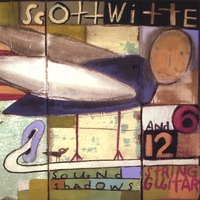
Review : Scott Witte “Sound Shadows” CD (Piggy Rooster Records, 2007)

Scott Witte Sound Shadowsby Raymond Morin

When I first encountered last year’s Wayfaring Strangers – Guitar Soli compilation by the excellent Numero Group reissue label, I’ll admit that a lot of it blew right past me. The disc is a collection of music by some lesser-known guitarists who had cropped up in the era between the establishment of the watershed Takoma Records and Windham Hill labels, the recordings dating from the end of the 60’s to the dawn of the 80’s. The tracks, generally speaking, tow the line between highly physical Fahey/Kottke pattern-picking and the more heady, “New Age” atmospherics of the Windham Hill sound, without really charging headlong into either style.

Today, many pickers from Detroit’s Nick Schillace and Philly’s Jack Rose, to Israel’s Yair Yona are finding their audience by keeping the Takoma sound alive and well, boom-chicking their hearts out with the same spartan spirit and intensity as John Fahey in his heyday. In parallel, world-wide interest in atmospheric and impressionistic acoustic and electro-acoustic music has never been stronger, and a healthy lineage of avant-garde-leaning musicians from David Grubbs to Chris Brokaw to James Blackshaw to David Daniell have torn down and rebuilt “New Age” (now “Ambient”) guitar music for a new generation.

The players featured on Guitar Soli, in their day, were operating in a similar, albeit more isolated environment. Without today’s mass communication tools, like the luxury of instantaneous access to virtually any and all recorded music via the web, it would seem natural for these players to drift toward one end of the spectrum or the other, riding the respective tides of enthusiasm for more traditional or more contemporary musical ideas… but we’re talking about guitar players here. Great guitar players do what they want, when they want, regardless of the tastes and trends of their time… and that’s a beautiful thing. The world of music is not black and white, and much of the thrill of discovery, for musician and fan alike, comes from mining the rich territory in between established norms. This “in between” guitar music takes a little extra time, a little bit of attentive listening before it really starts to shine, and then it’s well worth the effort… so it is with many of the players on Guitar Soli, and so it is with Scott Witte.

Scott is a Milwaukee-born guitarist, currently residing in Washington state. Scott remains a relatively unknown quantity in the world of fingerstyle guitar. He’s bound to gain some purchase with “Sailor’s Dream”, his standout track on the aforementioned Numero Group compilation, an animated little tune which owes no small debt to the playing of Leo Kottke. Witte’s debut album, also titled Sailor’s Dream and originally released in 1980, is still pending reissue, but fans of six and twelve-string acoustic guitar music would do well to seek out Sound Shadows, his 2007 collection of originals. Recorded between 2002 and 2007, Scott’s sophomore album sees the guitarist composing and performing with astute passion and creativity, picking up where “Sailor’s Dream” left off, but with an appreciable evolution of technique, harmony and song structure.

The album starts off with “Song of the Crow”, and an eye-roll inducing sample of, you guessed it, a loud crow “KAW!” My first instinct : “How much effort would it take for me to manually edit that out of the MP3 version, so I never have to hear it again?” All is forgiven, though, when Scott launches into the song itself, which is a finger-picking tour-de-force, and a great introduction to the elements of his style. A forlorn, minor-key meditation snowballs into a gorgeous set of guitar patterns, effortlessly moving back and forth between conventional and odd time signatures. It’s quite a trip, and sets the bar very high for the rest of the record.


Scott Witte – “Song of the Crow”
.
“Time Enough” features some percussive fret-board whacking which segways into a 70’s-rock inspired strumming section. “Bounce” should appeal to fans of uplifting, major key picking motifs. “Sweet Reminisce” and “Land of the Setting Sun” are slow, minor-key dirges, and “Land…” contains some interesting techniques that you don’t hear very often, such as fretting the high string on the side of the neck to create high-pitched hammer-on effects, a la Davy Graham. The interwoven strumming, mournful basslines and unexpected chord changes also put me in mind of Peter Finger’s classic “Wishbone Ash”.

“One Last Time” is all joy and effervescence, the buoyant chord clusters being played in an unusual 7/8 pattern. It’s a real showcase for Mr. Witte’s clean right hand technique, but it also illustrates how he transcends the American Primitive style by thinking about the voice of the entire chord, rather than droning two or three notes and throwing down a simple repeating melody over the top.


Scott Witte – “One Last Time”
.
At this point in an album, and with so much ground covered, one might start to worry about the well of ideas beginning to run dry… but Scott is just hitting his stride. Sound Shadows reaches it’s creative apex with “Inward Journey”, a composition that cycles through many movements, each more striking than the last. Much like James Blackshaw, one of the better-known modern-day purveyors of the long-form acoustic guitar song, Scott deftly picks his way through some gorgeous groups of chords, alternately accentuating notes in every register. That Mr. Witte is a virtuoso shouldn’t be a mystery to anyone at this point, bouncing back and forth between finger-rolls, time signatures and melodic snippets with the greatest of ease.

Genre-blurring acoustic guitarist Scott Witte

Genre-blurring acoustic guitarist Scott Witte

The album begins to wind down with “Walking On Air”, which revisits the sad, dirge-y mood of some of the earlier tunes. A short poem, “One Day Came a Crow”, reminds us of the loose concept of the album before closer “Prayer For Peace”, a very pretty pattern-picking invention in 5/8.

Though the few quirky “New Age” devices/trappings (the crow theme, the spoken word, etc.) at times threaten to cheese-up the proceedings (I know, right? Such a literate review and the best I could come up with was “cheese-up”), they prove minor distractions, relatively benign in the greater scheme of things. Sound Shadows is a serious, and seriously accomplished guitar album. The recording quality is very good indeed, the 12-string numbers featuring nice, thick close-micing, while the 6-string compositions benefit from the added sparkle of a little electric pickup mixed in. It is no small accomplishment that this group of songs, recorded intermittently over a five year period, are so of-a-piece… this collection could be sequenced any number of ways and would be no worse for the wear, a testament to Scott’s ability to keep things consistently varied and exciting. Though Scott Witte has been off the radar for some 28 years, with Sound Shadows he proves that he is not only in step with the current acoustic guitar scene, he also has the potential to be one of its leading lights.

Buy this CD from CD Baby
Check out Scott’s website

Review : Denis Turbide “s/t” CD (Self Released, 2009)

Denis Turbide s/t CD Cover

by Raymond Morin

This short, self-titled collection of instrumentals is the first by Canadian fingerpicker Denis Turbide, and it’s certainly a lovely little debut. Denis has a clean, easy-going style, and his compositions are informed by both classic fingerstyle and classic acoustic rock.

Opener “A Little Bit” is a fine example of Denis’ relaxed approach, with a healthy mix of arpeggios and hammer-on riffs, both in the high strings and the middle-bass… but it’s the song that follows, “Samuel”, that I consider to be Denis’ signature tune. The feeling is upbeat and hopeful from the first chord, with some nice, light snapping on the bass strings. A playful hammer-on riff is explored over several chords before a few short but exuberant rounds of strumming. “Samuel” is a great example of effectively composing in DADGAD, without sounding overly/overtly DADGAD… if that makes sense!

Tablature for “Samuel” (PDF)

Third track “Derivatives” starts heading more in a Euro direction, albeit by way of Stefan Grossman… reminds me a little of Grossman’s Shining Shadows period… clean, steady boom-chick over a few two-chord vamps. In a way, this song might be the weakest in the bunch, as that it struggles to find a memorable melody… from a technical standpoint, the recorded performance is very clean and very fine.

Next up is “After The Battle”, a very appropriately titled song. Denis is in the classic John Renbourn open G minor tuning, and the music very much conjures images of a battlefield being surveyed, with a melancholy that suggests the old adage “Nobody wins a war.”

Tablature for “After The Battle” (PDF)

The opening riff of “Havre-aux-maisons” is again very evocative of Renbourn, but at his most effervescent. It reminds me of “Glastonbury”, from his obscure Lost Sessions record. “Havre…” is a jubilant little tune that, like many of the others, cycles through its themes and flies by without overstaying its welcome. Perhaps the musical climax of the disc, since the closing song, “Firstborn” seems to echo the ideas of the earlier tracks.

All tablature by Alois Kleewein, provided by Denis Turbide.

Buy this CD from CD Baby
Check out Denis on Myspace