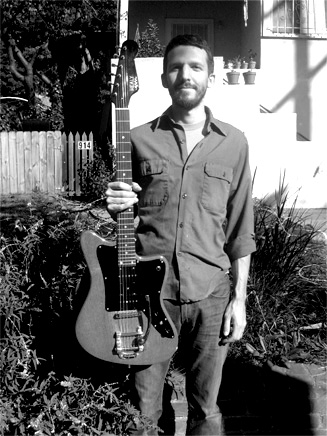
Trevor Healy is a guitarist, repairman and luthier based in the San Francisco Bay area. In addition to playing in the group Meridians, Trevor composes for solo acoustic guitar, and was tapped by Sean Smith for the new Beyond Berkeley Guitar collection, out now on Tompkins Square. We recently talked to Trevor about his appearance on the comp, as well as his approach to building and playing the guitar.
W&W: Please describe the guitar you play on your track, how long you’ve owned it, where you got it.
The guitar is a Stella 12-string, made by Harmony sometime in the 1960’s. I got it on EBay about 6 years ago after becoming interested in Leadbelly’s 12-string playing. When the box arrived, I realized that the guitar had not been taken out of its case since the 60’s, but needed a ton of work to make it a playable instrument. Like many Harmony guitars, its body is made of plywood and the neck is poplar, which some consider low-grade materials. It’s light weight and darker tone spoke to me though, and I thought it had some real potential to become a decent instrument. So, I re-set the neck for proper bridge and action height, made a new bridge and saddle, radiused the previously flat fingerboard and re-fretted it. Acoustically it is pretty quiet and has an almost lute-like tone. I have come to love this quality. I then put in an under-saddle piezo pickup to amplify the sound in live situations. When I first plugged in the guitar, I was blown away by its tone. I have played it almost exclusively since then. Continue reading →
Earlier this year, Anova Music released Remember, the solo instrumental debut by Israeli acoustic artist Yair Yona. The CD is an affectionate tribute to various American and British folk guitar styles, with Yona picking on 6 and 12-string guitars, a National-style resonator, and various other acoustic instruments.
Yair is fantastic… that album is one of my favorite guitar records of the year. Production-wise, it’s very ambitious, and quite smart, and in terms of both composition and technique, there are two or three tracks that I think are as good as anything ever done on the guitar. Obviously his album wouldn’t exist without his influences… but it rises above being merely derivative into something beautiful and, occasionally, even sublime.
As a nod to Yona’s drone and indie rock influences, there are also splashes of synth and assorted ambient effects on some of Remember’s tracks, though these are mostly relegated to background atmosphere… for the most part, Yona keeps his guitar playing as the focus of his compositions.
W&W : How old are you, and how long have you been playing the guitar?
Yair : I’m 28, been playing [music] for 13 years. Most of that time I played bass, until the winter of 2003, when I grabbed an acoustic guitar and started a whole new journey.
W&W : Take us through the evolution of your playing… when did you start working with acoustic instruments? Was it something you moved toward after the discovery of your European and American folk and guitar influences? Did you learn your fingerstyle techniques from emulating recordings, did you use TAB, etc?
Yair : Well, I was playing bass for couple of years, and was really into psychedelic rock and prog. In 2002, I moved to London and a couple of months afterward, I heard the first Bert Jansch album, which totally changed my life and made me realize that I’m much more into that now. His technique was so breathtaking, I almost lost the will to play. But at some point, I managed to learn one simple tune of his, which gave me the strength to move on and learn more tunes and practice. At first, I had to use TABs, as my hearing was rusty and I couldn’t figure out how the guy combined the two elements of bass string playing along with a melody and rhythm. The guy is a genius. No one plays like him, and I wish he’d be my neighbor. I’ll trade glasses of sugar and milk for 15 years, for one guitar lesson from him..
W&W : Which Bert song was the first that you learned to play? When I first started playing fingerstyle, I taught myself “Runnin, Runnin From Home” from the album, but ended up with a completely convoluted fingering that made it way more difficult to play than it had to be! A friend later found a TAB online and set me straight!
Yair : We share the exact same story! I figured “Running…” was the more “easy” song on the album, so I started with it. I had no idea about alternate bass, so I made up some terrible chord positions to try and understand how to play that. Only later I found a TAB for it and realized how it should be played. When I managed to play “Angie” for the first time, it was the happiest day of my life! (More on the day I first heard Bert’s album can be found here) One of my favorite tunes of his is maybe his easiest – “Bright New Year”. But the all time favorite song for me is “Fresh as a Sweet Sunday Morning”…
W&W : Please describe the instruments you used on Remember.
Yair : Well, in terms of my guitars, there were only three. The 6-string is an EN guitar, which a friend of mine built me as a practice for the guitar workshop lessons that he took. The EN was built based on a Martin 000 model. The 12-string was a Fender, which I sold to buy a brilliant Larrivée. The Weissenborn was actually a simple Vineyard guitar, and right after I finished the recordings, I bought a Goldtone. Still have the Vineyard, such a wonderful guitar, especially for its price. The Royal resonator is a cheap resonator I bought to see how I’m doing with this type of guitar.
W&W : You replaced your 12-string with a Larrivée 12? What body style, model number?
Yair : The Larrivée is a new LR-03-12.
W&W : Does Israel have its own instrument manufacturers, any popular regional guitar makers? Are the popular US brands like Martin, Gibson, Taylor etc available / widely used?
Yair : There are no REALLY famous guitar builders, maybe there are manufacturers who build really few pieces a year. The American firms have some representation, but usually in the acoustic guitar rooms, you’ll find a few Martins and Taylors, usually way overpriced, and the variety of models doesn’t exist. You won’t be able to find a good 12-string second hand. It’s not a popular instrument in general, and it’s much less in a country of 6.5 million people.
W&W : Talk about your right hand… thumb pick? Fake nails? Acrylics? All natural?
Yair : Thumb pick, plastic Dunlop one. Other fingers are my natural nails.
W&W : What are the tunings you use on Remember?
Yair : Most of the tunings are open D (DADF#AD), where “Broken Rockin Chair” is in G minor (DGDGBbD), “Floodgate” is an open C (CGCGCE), and the most complicated one is on “Skinny Fists”, which is DGDF#G#C#. It’s a tuning I learned from Glenn Jones, who’s by far my favorite guitar player in this style.
Yair Yona – “Brave Walls”
W&W : Please describe the recording of Remember… did you record it yourself or were you assisted? Studio?
Yair : I was fortunate enough to become a label manager of Israeli alternative label Anova Music and we have our own studio, so I was recorded by a great engineer called Ronen Roth. We recorded the guitar tracks on a 2 inch tape, using U-87 and 67 [microphones].
W&W : Do you have plans to do any touring in 2010?
Yair : There’s a great will, just trying to figure out how to handle the road with 3 guitars, and how to avoid work for two weeks without having to be worried that something happened to my company!
W&W : What other projects are you currently involved in that you would like to talk about?
Yair : Well, I’m writing new material and I’m working on a new band that I’ll play bass in, of some experimental, noise and psych music. I want to have my own Faust. Or Califone, whatever comes first.
W&W : What albums are you listening to most at the moment?
Yair : At this very second, I’m listening to the brilliant Pockets by Karate. I’m checking my LastFm page to see what else I’ve listened to today (because I’m listening to a lot of music, with a variety of styles) – I listened to Mudhoney a lot because they are coming to Israel in couple of days, which makes me very VERY happy. The Churchills, psych rock from Israel 1969, The Veils new album and Arthur by The Kinks. The new Califone is brilliant, and the record of the month or maybe the year is the new Black Heart Procession. YEAH!!!
W&W : Could you talk a little about your blog and your mixtapes?
Yair : Sure. I run an alternative music blog called “Small Town Romance”. Now it’s only in Hebrew, but in a month and a half, I plan to have an English version of the blog, with a translation for each post. The idea behind it is to expose people to good music that sometimes is left behind, and slips under the radar. Once a week I post a mixtape of good music, an hour of great sounds of stuff I’ve listened that week. I love being an ambassador of music and exposing people to records that may change their lives. It’s somewhat naïve, I know, but when someone comes to you and says “The record you recommended me just made my week!” – it’s the best thing ever. That’s why I went to work in a record store a couple of years ago. I remember someone told me that me selling her No Other by Gene Clark got her out of a serious depression she was in. Who could ask for more?
Over the last couple of weeks, I’ve gotten to know Denis Turbide, a very fine fingerstyle guitarist from up Canada way. Denis has a self-titled, self-released CD out now… you can read the Work & Worry review here. The man also obliged W&W with a nice interview, presented below.
W&W : How old were you when you started playing guitar?
Denis : I was 13 years old when my parents got me a classical guitar for Christmas, and I took lessons for a few months after that.
W&W : When did your interest in fingerstyle guitar develop? Please talk about your early influences… what moved you to work in the style?
Denis : There was always fingerstyle, right from the start. It was a classical guitar my parents had given me, after all. My dad was a classical/opera guy. He sang on French-Canadian radio and early TV with choirs when he was younger. He wanted me to play classical guitar.
My first teacher taught me Beatles and Supertramp…the pentatonic scale. I had a classical teacher after that first summer but I didn’t like reading music. At the same time, I was listening to, and trying to learn, a lot of Simon and Garfunkel, Cat Stevens, Beatles, Led Zeppelin, James Taylor, Neil Young, America… obviously anything acoustic. Jimmy Page’s acoustic playing is still some of my favourite music.
W&W : Did your dad enjoy the rock and pop music that you were getting into? Could he appreciate the stuff you were working to learn?
Denis : Dad was a real Bach, Beethoven, Vivaldi, Rossini, Leoncavallo kinda guy. Glenn Gould, Yehudi Menhuin, Mario Lanza, Pavarotti, Beverly Sills, Maria Callas… Pop [music], when he was young, was Elvis and Chuck Berry, but Dad didn’t dig it too much. Classical music did rub off on me, though. I love hearing Bach especially. Some of the most incredible and powerful music ever written. All that said, I’m sure he could sing a few Beatles tunes…
W&W : So you gave up on the lessons pretty early on, and decided to follow your ear? How long was it before you switched over to steel strings?
Denis : The lessons I did for about 8-9 months altogether, over the course of about a year and a half. I learned fast and nobody ever had to force me to practice. I knew a lot of chords, found changes and learned new songs all the time. The next guitar I got after 2 years with the classical was a 12-string. I guess I didn’t play much fingerstyle on it, but I’m sure I played some… we’re talking some 25+ years ago.
W&W : Have you always flown solo, or did you spend any time playing in groups?
I wasn’t ever really in a group. There was a duet for while, over a decade ago, but since then it’s been pretty much me.
W&W : What tunings do you use on your recent s/t CD?
Denis : “A Little Bit” is in standard, “Derivatives” is dropped D, “After the Battle” is in DGDGBbD (open G min) and then DADGAD for “Samuel”, “Havre-aux-maisons” and “Firstborn”. My new tune, “That Face”, is in open G or DGDGBD.
W&W : You have a lot of YouTube hits and a lot of people requesting TABs for your songs… it has obviously been very good exposure for you, but how do you feel about the internet and social networking sites (Myspace, etc) and how it relates to the essence of playing guitar? Do you think it’s a natural progression from learning about guitar through books, concerts and albums?
Denis : How it relates to the essence of playing the guitar? Natural progression? Not sure about that but it’s been helpful getting the music out there, [though] obviously it does take up a lot of time getting things together. There are so many different sites now as well. How does anyone choose the one(s) that will get the most exposure? They all want you to join their site and all of them say that they will get you noticed….blah, blah, blah.
It is fun being an indie artist, though. Everything I’ve acheived so far is all because of the effort I put into it. The fact that people actually ask for my tabs is still a bit mindblowing for me, though. Sure, I’d love for more people to hear my music and to love it, but the fact that some out there want to actually learn my stuff is pretty exciting.
W&W : What was the process of getting the TABs together?
Denis : I checked around online looking for someone who tabs out tunes as it would have taken me a long time to do it. Writing out a few bars on some tab paper with a pencil and doing a whole tune on a computer are two different things. Alois Kleewein checked out the tunes… he really liked “Samuel”. He sent me some Tabledit previews, then he ran them through some software he’s got. They came out pretty nice. He plays in a funk band in Austria and we’ve only ever communicated online.
W&W : Talk a little bit about the guitars you’re using, string gauges, fingerpicks or no? Do you use the ring finger when you pick, thumb and two fingers, no particular approach?
Denis : I’ve been playing Larrivées for the last few years. Great guitars. Late last year, some members of the Larrivée online forum came up with some specs for a custom model that I was really interested in. It’s a smaller version of their proprietary L model, an LS, but they made it with a 12 fret neck, which I love. Mine has an Italian spruce top and mahogany back and sides. Outstanding.
Denis' Limited-Production Larrivée LS
For the CD, I used an L-03R and OO-50, both Larrivées and both I no longer own. The new LS I used for [the new recording] “That Face”. Uncoated D’Addarios are pretty much what I use when it comes to strings. The plain old EJ16, phosphor bronze light gauge. Their quality is consistent, they’re cheap and everyone has them in stock pretty much all the time. I’ve never been able to use finger/thumbpicks. I use a combination of flesh and nail when it comes to the picking, and I do use the ring finger as well. When I used to teach, I would tell the students to use the ring finger for the first string, middle for the second, index for the third and the thumb was for the top three. But then, no rule is written in stone.
W&W : Earlier this year, you talked about pursuing gigs again, after a pretty good hiatus… how has that been going? Do you see any touring in your future to promote this or future releases? Any upcoming gigs to report?
Denis : I would love to tour and stuff but I’ve got shared custody of my 3 and 6 year old sons, a full-time job, a mortgage… responsibilities. I’m not 20 anymore either! I should be more proactive, more aggressive but I’ve got so much going as it is. I’d love for this to become a career but, as everyone knows, the music business isn’t exactly a steady job with a regular paycheck. I have a regular monthly gig in Ottawa, Ontario at a pub called Woody’s. Great place. I started playing the open mic on Mondays about 2 years ago. It’s a relaxed, no pressure kind of place.
No future releases in the works right now but that could change if I come up with something new.
W&W : What cover songs are in your current repertoire? Which songs, cover versions or originals, do you find the most challenging to play?
Denis : My repertoire includes just about anything I can remember! I’ve been learning songs and pieces for nearly 30 years so there’s a lot that I forget I know how to play. Some of my favourites are up on YouTube now… “Little Martha”, “Never Going Back”, “That’s the Way”, and “Take Five”. I do a fingerstyle/vocal version of “Whiter Shade of Pale”, “Fragile” by Sting… I’m a big Beatles fan, so I do a bunch of their tunes like “Blackbird”, “Norwegian Wood”, and “You’ve Got To Hide Your Love Away”. I do a couple of [Pierre] Bensusan tunes, John Renbourn’s “Luke’s Little Summer”… that’s one of my all-time favourite pieces on the guitar.
W&W : Your picking style seems to have a healthy dose of American Primitive influence (Kottke, Fahey, Takoma Recs… steady boom-chick with melodies in the high strings, etc..) Would you say that that was an important influence, and have you kept an eye on the current crop of American Primitive-style players?
Denis : Well, I started learning the alternating bass thing way back with tunes like “The Boxer” and “Dust in the Wind”… still play those live too! But Leo Kottke, Fahey… amazing players. I don’t really play any Kottke tunes but there are some that I love… anything off of 6 and 12 String Guitar… wow, what a great album!! Jerry Reed’s “Heavy Necking” book… great stuff for any picker in there! I’m not really familiar with much new music/players these days. It appeals to me but I just can’t seem to find the time to really listen and enjoy. I barely have time to sit and play myself!
W&W : Your children seem to be one of your biggest inspirations. Do you think your children might follow your lead and become players?
Denis : My kids are my life. I’ll love them no matter what. I’m not sure if they’ll ever want to play, let alone want to play with the old man! I just want them to be happy with whatever they choose to do. That’s all any parent can hope for.
 by Raymond Morin


 WORK & WORRY