In the avant-rock band Cul de Sac, guitarist Glenn Jones and his bandmates combine fingerstyle electric guitar, krautrock rhythms and harsh electronics, creating a challenging, textured sound that defies categorization. In 1997, the group famously collaborated with acoustic guitar icon John Fahey and released the album The Epiphany of Glenn Jones. Now, over a decade later, comes the third solo outing from Jones, and on Barbecue Bob in Fishtown the spirit of John Fahey and his American Primitive approach is alive and well.
Though his band is known for their experimental leanings, Glenn Jones the solo artist is considered something of a traditionalist, and the Barbecue Bob… package is very much presented in the grand tradition of instrumental acoustic guitar collections of years past. From the light-hearted cover image and the eloquent, self-penned liner notes to the tuning references and instrument notes for each song, the art direction has a classic feel… the album could pass as an artifact from any point in the last 40 years. When the included booklet is flipped over and reversed, we’re treated to a photo-diary of Jones paying a visit to Belmont Nails, for what appears to be an application of fresh acrylics. All of this is the kind of stuff that guitar geeks eat up, myself included!
Well, as everyone knows, the best compliment to great packaging is great music (to listen to while staring at the great packaging, of course!) and on Barbecue Bob in Fishtown, Jones delivers some fine picking indeed. The album kicks off with the upbeat alternating bass of the title track, the bends and rolls evoking both Fahey and some of the modern purveyors of his style, such as Nick Schillace and Jack Rose. Jones’ style immediately stands apart from those players in its more relaxed attack, never quite approaching the tidiness of Schillace or the determined physicality of Rose. I find the easy, slightly ragged character of Jones’ picking to be very charming, particularly on “Barbecue Bob…”, “Dead Reckoning” and album closer “A Geranium For Mano-a-Mano”.
Glenn Jones – “A Geranium For Mano-a-Mano”
There are two brief banjo pieces on the album, and both are compelling listens. Mood and tempo-wise, “Keep It A Hundred Years” and “A Lark In Earnest” are very similar, a possible product of Jones’ relative newness to the instrument… but in spite of this, his knack for composition wins out, and the banjo songs stand up as some of the most melodically driven on the album. “Keep It…” contains some unexpected chord changes, keeping it interesting and unpredictable, while “Lark…” benefits from a simple, memorable melodic theme and some very nice finger-rolls.
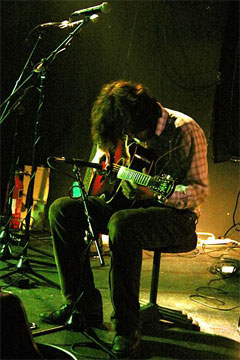
Glenn Jones in action
“1337 Shattuck Avenue, Apartment D”, Jones’ tribute to Robbie Basho, is one of the most emotive tracks on the disc, and also its longest. In the liner notes, Jones explains that this loosely structured composition was one of many takes, and was chosen for its “uncertain” feel. There is definitely a palpable degree of uncertainty in the playing, with many of the notes fretting out around the 4 1/2-minute mark as Jones begins descending into dark, dissonant territory. Still, the emotional thread that runs through the song, coupled with the variety of the sections, keeps the listener wholly invested.
My favorite song on the album is “For Wendy, In Her Girlish Days”. This selection contains some of Jones’ most delicate and beautiful playing, and its primary theme is a nice hybrid of Leo Kottke-style alternating bass and chord voicings, supporting a vaguely British-tinged melodic approach.
Glenn Jones – “For Wenday In Her Girlish Days”
Glenn Jones is something of a staple in the current solo acoustic guitar movement, and Barbecue Bob in Fishtown makes a great case for why that is. Jones’ playing shows him to be a guitarist with a distinctive touch, an experienced player with a pleasing affection for traditional picking as well as a flare for varied and innovative composition.
Earlier this year, Pairdown, an acoustic duo that I play guitar and sing in (alongside Mr. David Leicht) released our debut LP Holykyle. It was the product of plenty of time, hard work, love… and a whole lot of beer! It was all worth it, though, when the test pressings arrived and I heard our music on wax for the first time. Here, I thought, is something that will last forever. Holykyle was released on Sort Of Records as a vinyl edition of 315 copies, and being that our act is new and relatively unknown outside of our home base of Pittsburgh (who am I kidding… we’re unknown in Pittsburgh, too) I figured that if Pairdown wanted to sell some records, we would have to get on the road. Touring is a fact of life for indie artists, one of only a few dependable ways of conquering new territory and spreading the good word about a new group.
Of course financial, family and work concerns all have to be considered when planning a (potentially money-losing) trip… because of these realities, my partner David would only be able to take to the road occasionally, while the relative flexibility of my schedule meant that I could travel somewhat regularly. We came up with a strategy that has served us well : we would play as a duo for local and certain higher-profile gigs, with each of us taking the periodic solo jaunt to keep the album on peoples’ minds. Thankfully, we’ve got a good number of songs under our belt at this point, and many of them can be pared down (yup, I went there) to a single voice and guitar when the need arises. Using this approach, we arranged several very exciting duo shows in Pittsburgh, including gigs with Sub Pop recording artist Death Vessel, the electro-acoustic drone duo Mountains, the inimitable Micah Blue Smaldone, and Pittsburgh’s own Daryl Fleming, David Bernabo + Assembly, Horse Or Cycle, Chris Neils, and some others. We also took a few exciting trips out of town, playing in Chicago, Cleveland, Youngstown and Turner’s Falls (western Mass). Sometimes we expanded to a four piece, which included drummers Jim Powell or Matt Leicht (David’s younger brother), and my girlfriend Minette Vaccariello on keyboard-bass.
In addition to the increasingly busy local schedule, I was able to go on solo trips every month or two, the most recent of which is the subject of this little tour diary. Booking this tour couldn’t have gone more smoothly, and the itinerary was exactly what I’d hoped for : six shows in a row, no drive longer than five hours, no back-tracking. I was thrilled at the prospect of playing with a couple of my favorite pickers, some very old friends, and a few people who I don’t see nearly often enough.
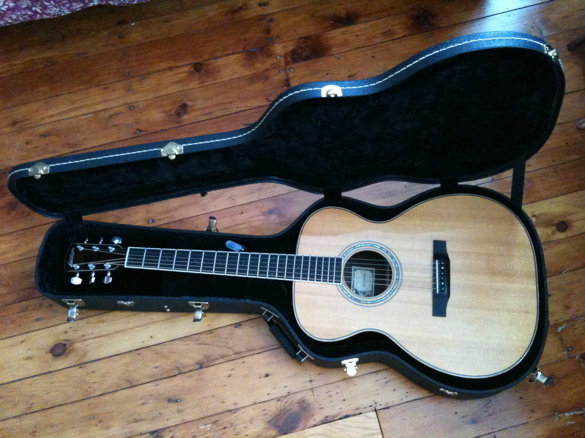
My guitar, a Larrivée OM-09
Before the trip, I decided that my acoustic guitar, a Larrivée OM-09, was long overdue for a setup, so I brought it to Dave Mannella at Mannella Guitars in Verona, PA. Dave set about leveling the frets and replacing the nut and saddle (my constant tuning changes had gradually worn them down, causing more than a little fret buzzing). When I got the guitar back, she played like a dream.
DAY 1… PHILLY, PA
I packed up my guitar, cables, clothes, LPs, my recently-washed sleeping bag, my trusty farm-animal-themed blanket and a pillow, and after a quick 3-hour shift at work (I was going to be missing several days, after all, figured I’d get some hours in) I was ready to hit the road.
Minette and the infamous pout
Because of the G20 summit, which was happening in Pittsburgh that weekend, most of downtown was shut off to traffic and Minette had a day off. As usual, I said my goodbyes, and she made her infamous pout-face.
The ride to Philadelphia was an easy one. It was a beautiful day, and I enjoyed the drive. For the past couple of years I’ve been more or less completely dependent on GPS on these trips, and, as usual, I just took the first route that the Garmin offered up, which was the turnpike. I’ll think better of it next time, though… I hadn’t made the trip directly from Pittsburgh to Philly in a while, and my jaw dropped when I had to pay the first toll of the journey : $19.10!!! I resolved to take a different route in the future.
I arrived in Philly around 6pm and met up with my friend Rob Dingman, who had organized the show. He opened up the space for me to check out, and I couldn’t believe the size of the room! Rob explained to me that in the past, property was taxed not by square footage but by how much space it took up on the sidewalk, which is why many of these buildings in the Old City were narrow but quite long. I strapped on my guitar and walked around the space, practicing and listening to the fantastic echo sound in the room. Before too long, The Shrinking Islands, old friends and one of the openers that night, arrived and loaded in their gear. Cases of beer were opened, and the festivities soon began.
Though there weren’t a great many people in attendance, the show turned out to be a blast. Local duo Heirloom opened, which featured Meggie Morganelli switching between acoustic guitar, piano and Appalachian dulcimer, and Stefan Zajic playing acoustic and electric guitars. Their sound was somewhere between a coffeehouse-friendly singer-songwriter style and more modern, hushed indie-folk. I really enjoyed the sound of the dulcimer in the cavernous space.
Meggie and Stefan from Heirloom
The Shrinking Islands delivered much jangle-pop goodness in their short set… I had put out a record by this electric-guitar-and-drums duo on my label back in 2006, and though they were no longer performing regularly, and hadn’t played together in several months, they didn’t miss a beat. Singer/guitarist Kyle Bittinger’s high-energy picking and pogo-ing and drummer Andy Tefft’s busy fills put a smile on everyone’s face and a tap in everyone’s feet.
My set went just fine, perhaps not transcendent, but with no blatant screw ups, either! I opened with “Untitled For Holly” off of Holykyle, which was easy on the fingers and a good way to slide into the set. I stayed in standard tuning for the first half, performing Stefan Grossman’s “Bermuda Triangle Exit”, Davy Graham’s “Forty Ton Parachute”, and my own “Metal In My Mouth”. Several tunes were played for the first time in front of an audience, including Archie Fisher’s “Lindsay”, and the Milo Jones classic “I Belong To You”, which I was playing in a new, higher key. Though I had planned a pretty concise set, Rob got me to extend it, asking me to keep playing since his wife Jamie was on her way over. I played a few more tunes, and closed with Graham’s classic “Anji”.
Meggie picks on my Larrivée after the Philly show
When my set was done, Meggie proceeded to geek out hard over my little Larrivée, so I let her pick on it for a while. She told me that she was saving up to get herself a Martin OM, which she was planning to buy directly from the Nazareth factory. We vowed to become Facebook friends, and she promised she would send me a picture of her new instrument when she got it.
It was starting to get late, so Rob, Jamie and I went back to their place, talked for a little while and called it a night.
DAY 2… UNION, CT
After a late breakfast with The Shrinking Islands and friends, I set off for the woods of northeastern Connecticut, the region where I grew up. It was another pleasant, sunny day, and knowing that my GPS would surely take me straight to the traffic and tolls of the George Washington Bridge, I decided to map out a different route, north on the Garden State Parkway. It was a smart move, and I managed to avoid traffic and see some truly lovely autumn scenery, particularly crossing from New York state into western Connecticut. I busied myself singing Ewan MacColl’s “The Terror Time” in several different keys, trying to decide which one would best suit my voice. Around 6pm, I arrived at my old friend Terry’s house on the Eastford/Union town line, greeted by Terry, his wife Sarah, and a couple of very excited dogs.
My old friend Terry
I would normally do a show in western Massachusetts en route to the east coast, but this time out I was having a hard time pulling one together. Terry and Sarah graciously offered to have a little party in my honor, a nice, relaxed affair to play some music and catch up with old friends. We had a terrific time, the guests brought amazing food, Terry grilled up some turkey burgers and had a mini-keg of Allagash White (my favorite beer, and generally hard to find in Pittsburgh) at the ready. When it was time to get down to the performances, my old friend and band-mate Jay Yonush opened up with a short set of uptempo, whiskey-soaked country songs, which he performs under the moniker Rum Glass Serenade.
My set was loose and fun, and I played most of the same songs as I had in Philly. A lot of the people at the party were kind enough to buy LPs, CDs and t-shirts to help me on my travels, and we stayed up late into the night, listening to music and catching up… Terry and I hadn’t seen each other since playing together in The Parallel Gawdheads, our version of a surf/ska/punk band, way back in 1996. Back then, Terry was endlessly championing Frank Zappa, which I didn’t understand at all (I had the more typical teen-angst driven fixation on loud, post-punk bands like Unwound and Fugazi). Of course, about a decade later I became an incurable Zappa fanatic, which I remain to this day.
One by one, the guests all said goodnight and went home. I unrolled my sleeping bag, played on my phone for a few minutes and fell asleep.
DAY 3… PORTLAND, ME
I awoke to an amazing breakfast of egg and mushroom burritos, courtesy of Terry and Sarah. I didn’t have far to go that Sunday, so we all lazed around for a while, and I noodled on Terry’s Stratocaster while he burned me a bunch of mix CDs. When it was finally time to go, the weather had changed quite a bit from the previous day… it was grey, cold and rainy outside, and I took a quick detour through Putnam and Woodstock, trying to recognize some of the backroads of my youth. I made my way to Maine, where I was to play at a new theater-style venue called The Apohadion.
The room wasn’t difficult to find, situated in a semi-industrial section just around the corner from downtown Portland. I was excited to be sharing the stage with Micah Blue Smaldone, one of my favorite guitarists and songwriters, and a Maine native. He arrived at The Apohadion shortly after I got there, and he, his girlfriend Rebecca and I departed for some pre-show Japanese food. I wasn’t very hungry, so I contented myself with a seaweed salad, while Micah and Rebecca shared a quite amazing looking spread of assorted sushi and fried delights.
We got back to the gallery and the room slowly started to fill up with people. By the time local opener Listo took the stage, a pretty nice crowd had assembled. Listo was the combination of Apohadion founders David Noyes and Pat Corrigan, lately of the band Seekonk, and local songstress Kelly Nesbitt. Their music was quite a treat, combining a lovely vocal harmony blend and the interesting combination of two nylon-strung acoustic guitars and Pat’s electric, treated generously with a wah-wah pedal. They sang several songs in English and several in Portuguese, and closed with my favorite Caetano Veloso song, “Canto Do Povo De Um Lugar”. Sublime!
Pat, David and Kelly from Listo
I took the stage next, and instead of making up a setlist, I decided to just write a bunch of songs down, divided up by tunings. The room was pretty full at that point, and I was a little nervous playing in front of Micah, who I consider to be a world-class picker. I did my best, though. Once again, I opened with “…Holly”, and played another song from the Holykyle LP, the folk-rock track “Good Wood”. According to my list, I played “Forty Ton Parachute”, though I don’t remember it… I threw in the old drop-D Pairdown chestnut “Threadbare”, and also played our newer “No Occupation”, which Micah later commented was one of his favorites.
The set went well enough, and I settled in the front row to watch Micah. He performed several tracks off of last year’s “The Red River” LP, my favorite of his three full-lengths. As an artist, Micah has undergone something of a transformation over the years… on his first album, “Some Sweet Day”, he conjured a very old-timey sound, playing on a National-style resonator guitar and singing in a pinched, affected voice. His songwriting has always been top-notch, though, and over the course of his next few releases, he gradually eased into a more natural singing style and a very moody, economical approach to the acoustic guitar, eventually relying almost exclusively on his Guild 12-string. His lyrics are at once elegant and stark, and his sad stories evoke another time. I was able to capture this video of “A Derelict”, one of my favorite tracks from the newest record.
After the show, we shot the shit for a little while, and Micah handed me what I later determined must have been most or all of the door money from the show, a very kind gesture. We drove over to his house in west Portland, and he put me up in his housemate Caleb’s (formerly of Cerberus Shoal and lately of husband-and-wife duo Big Blood) studio room.
DAY 4… CAMBRIDGE, MA
That Monday morning, I threw down on the most substantial piece of toast I’ve ever encountered, 2″ thick easy, on bread baked fresh by Micah’s housemate Sean the night before. It was quite tasty, and kept me from being hungry for most of the day. The short drive to Boston meant another easy morning, so we lingered for a spell, talking about the various upcoming projects Micah had happening around the house, from installing doors to working on his moped. I finally got to gettin’, as I’ve been known to say, and had a quick, uneventful drive over to Boston’s south end, where I met my friend Nate (who incidentally also mixed Holykyle) for lunch.
Kelley Shaw-Wade, owner of Pinkergreen
We had a fine lunch indeed, me devouring a large plate of drunken noodle with shrimp and chicken (can’t remember what Nate had… I was focused!) Nate had to work for a couple more hours, so I walked around the south end, and decided to visit my old friend Kelley Shaw-Wade at the offices of her Pinkergreen design firm. We had a nice visit, and soon I picked up Nate and we drove over to his place to relax before the show.
It was at Nate’s house that evening that I had one of the strangest, most modern experiences I’ve had in some time… Nate’s housemate John and his girlfriend Nellie had arrived, and we began talking about smart phones (my girlfriend had recently given me an iPhone as a gift, which I’d been using to document the tour with photos and videos) and the various music-related software applications that could be procured. John proceeded to download an interesting “virtual guitar” to his phone, and after a couple of minutes, got pretty proficient with it! Of course, Nellie and Nate had to get in on the action, and pretty soon we had a proper smart-phone symphony happening… all improvised, of course.
Before I knew it, it was showtime. The venue was Zuzu’s, a fantastic bar and restaraunt housed between the two entrances of the legendary Middle East Club on Mass Ave in Cambridge. I turned in a pretty good set, debuting a pair of new instrumentals. “Tanning” is in double-D-down tuning (DADGBD) and has become one of my favorite duets in Pairdown, but since it was originally designed around my guitar part, I figured I’d give it a try solo. It held up okay, but I definitely missed Dave’s complimentary guitar work. The other new instrumental, “Work & Worry”, is in DADGAD and is something of a fingerbuster, written deliberately as a solo piece. It took me a good 15 seconds silently looking at my fretboard to remember how it even started, but once I got going, I picked out a more than respectable version. Three of my all-time favorite acoustic guitarists, KG Fields, Milo Jones and Micah were in attendance that night, and they all voiced approval for the new material, which was very exciting for me!
Micah once again played wonderfully, quieting down the noisy room with his first song and keeping their undivided attention for the duration of his set. Unfortunately, it was raining cats and dogs outside, and the low-lit room was far too dark to shoot any decent photos or videos.
The final act of the night was Nate and John’s band Quoins, who defy classification. Though their music is economical, it isn’t minimalist… though it is powerful and sometimes loud, it isn’t “rock”. The lyrics and melodies are consciously intelligent and angular, and many of the songs had three part harmonies in the vocals. I was very impressed with their set. At the end of the night, Nellie and her bike hopped into my car while Nate and John went back to their practice space to unload. We all met up back at the house and went to bed.
DAY 5… BROOKLYN, NYC
Pete's Candy Store
On Tuesday afternoon, I slowly made my way toward New York City and Pete’s Candy Store, a lovely little bar on Lorimer Street in Brooklyn. I had played Pete’s a few years back with The Bee Gentles, a Bee Gees cover band that Minette and I formed to play tunes off of their pre-disco, Beatles-esque LPs. I’ve always loved the layout of Pete’s, the performance area being placed just off of the bar with a door in-between, perfect for quiet, intimate performances. The bartender, Sam, is one of the nicest in New York, and he gave me more free-drink tickets than I could use.
Well, my set that night was intimate alright… being the last act added to the bill, it meant that I would be playing around 8:15, before most people go out in NYC, including the other bands that were playing that night! For about a half-hour, I shared that little back room with a crowd of about ten folks, all of them waiting for their friends in other bands to show up. They lent me their ear, though, and I did my best to introduce them to my brand of fingerstyle acoustic music. I was done before I knew it, and since none of my NYC friends had found their way to the show, I decided that I would pack up and hit the road for home.
The drive home was pretty excruciating. If you’ve ever done NYC to Pittsburgh in the dark, it’s pretty boring to begin with… but when you factor in road fatigue, fog, rain and deer (I shot out of one of the tunnels and found myself alongside a huge buck, running in the same direction in the passing lane!) it makes for a long drive. With stops for naps and gas, that 4 ½ hour trip took me all night. I rolled back into the ‘Burgh at 7:30 AM.
DAY 6… PITTSBURGH, PA
Though I was back home, the tour wasn’t quite over. I had saved the best show for last, a Pairdown duo show at Morning Glory Coffeehouse, hosting and opening for the legendary Jack Rose. After a day filled with fitful attempts at sleeping, I drove over to Jeffrey Alexander’s lovely little coffeeshop and met up with David. David had been in touch with Jack throughout the day, and it turned out that Mr. Rose was at the very end of a month long tour of his own, and was pretty wiped out. To make matters worse, he got turned around trying to get into Pittsburgh, and had the potential of being in a very bad mood by the time he arrived.
Once Jack showed, though, a case of Lord Chesterfield beer was opened and everyone relaxed. I was thrilled to be reunited with my guitar playing partner, and we did a set of mostly new Pairdown songs, including recent instrumentals “Capitano” and “The D.Putnam Strut”, as well as “Cathedral”, our version of an acoustic blues. It was great to be back to the duo versions of “No Occupation” and “Spotted Eye”, and we closed the set with “Tanning”. I was very satisfied both with the way that we played and with the nice crowd that had filtered in to see us and Jack Rose.
As many acoustic guitar accolites are aware, Jack is one of the leading American Primitive-style pickers working today, and the heir apparent to the late John Fahey. His relentless touring schedule has made him an incredibly powerful and accurate player, and he performs slide, raga and back-porch instrumental guitar with the best of them. He played a little of each that night, ending his short set with a loud “That it!!” and leaving the crowd wanting more. I was completely satisfied, and glad that the night would wind down early.
Everyone agreed that the show had been a great success. Jack and David went back to David’s place in Allison Park, but I demured the invitation to come along, prefering to get home to Minette, the cozy red glow of my TV room, and then a good night’s sleep. The next day it was back to my job and normal life, if only for a little while.
Upon listening to the album and digging deeper into his back catalog, it’s clear that Reynolds has many interests, and that being associated with a a single style isn’t one of them. Thus, there is a little of everything on How Day Earnt Its Night… and though the recording quality is warm and clear, and Reynolds is a more than competent picker, there is a certain lack of direction that keeps many of these tracks from being home runs.
The songs generally fall into two categories : shorter, British Isles-flavored vignettes and extended Takoma-inspired explorations. Opener “Skylark (Scorner of the Ground)” takes the former approach, as Reynolds easily picks through some pleasant, stately figures. Though nothing revolutionary, the songs in this style are some of the best on the album, even if tracks like “Risen” and “England” rely more on the moods that they evoke than on any concrete melodic ideas. Reynolds builds most of these British-style songs around a simple alternating-bass with hammer-on riffs in the high strings, generally falling back on picking patterns and ignoring the harmonic possibilities in the chords’ middle voices. “Kirstie”, as lovely as it is, repeats the formula one last time, feeling a little like a song waiting for a singer.
Ben Reynolds – “Kirstie” .
Most of the remaining tracks move in a decidedly more American (Primitive) direction, and the results are, sadly, a little underwhelming. “Death Sings” is bargain-basement Takoma, borrowing liberally from the vocabulary of John Fahey but adding nothing new to the conversation. “The Virgin Knows” is an over-long bottleneck dirge, piling on almost nine minutes of hammer-ons and meandering slide riffs, but never really going anywhere. Reynolds tries to channel Lightnin’ Hopkins on “All Gone Wrong Blues”, but the tune’s recycled blues runs and ever-present harmonica make for a pretty tedious listen.
Ben Reynolds
The wild card on this collection is definitely the title track. “How Day Earnt Its Night” is the album’s centerpiece, sitting somewhat conspicuously between two of the aforementioned British-style tunes. “How Day…” opens with haunting three finger triplet-rolls on the high string, filling in over the course of the next few minutes with stark harmonics and staccato melodic fragments. The results are really pretty enchanting, reminding me of the hammer-dulcimer compositions of one of Reynolds’ soon-to-be-tourmates, Pittsburgh’s Mike Tamburo. Reynolds drops in some downtuned bass-note melodies, coloring the piece harmonically and adding more tension, before the still-blazing triplets are unceremoniously cut off around the eight-minute mark. The breakneck pace slows, and Reynolds noodles somewhat aimlessly for the remainder of the song… a disappointing anticlimax to what began as a very engaging and promising piece.
Ben Reynolds – “How Day Earnt Its Night” (excerpt) .
I’ve got a few discs from Reynolds’ back catalog on their way, and am looking forward to seeing him live this autumn. While How The Day Earnt Its Night lacks originality, it does present Reynolds as a restless and intriguing picker, with both solid technique and an internalized knowledge of a few beloved acoustic guitar styles… and because Reynolds stands to grow exponentially as both a player and a composer, I plan to follow his progress closely.
When I first encountered last year’s Wayfaring Strangers – Guitar Soli compilation by the excellent Numero Group reissue label, I’ll admit that a lot of it blew right past me. The disc is a collection of music by some lesser-known guitarists who had cropped up in the era between the establishment of the watershed Takoma Records and Windham Hill labels, the recordings dating from the end of the 60’s to the dawn of the 80’s. The tracks, generally speaking, tow the line between highly physical Fahey/Kottke pattern-picking and the more heady, “New Age” atmospherics of the Windham Hill sound, without really charging headlong into either style.
Today, many pickers from Detroit’s Nick Schillace and Philly’s Jack Rose, to Israel’s Yair Yona are finding their audience by keeping the Takoma sound alive and well, boom-chicking their hearts out with the same spartan spirit and intensity as John Fahey in his heyday. In parallel, world-wide interest in atmospheric and impressionistic acoustic and electro-acoustic music has never been stronger, and a healthy lineage of avant-garde-leaning musicians from David Grubbs to Chris Brokaw to James Blackshaw to David Daniell have torn down and rebuilt “New Age” (now “Ambient”) guitar music for a new generation.
The players featured on Guitar Soli, in their day, were operating in a similar, albeit more isolated environment. Without today’s mass communication tools, like the luxury of instantaneous access to virtually any and all recorded music via the web, it would seem natural for these players to drift toward one end of the spectrum or the other, riding the respective tides of enthusiasm for more traditional or more contemporary musical ideas… but we’re talking about guitar players here. Great guitar players do what they want, when they want, regardless of the tastes and trends of their time… and that’s a beautiful thing. The world of music is not black and white, and much of the thrill of discovery, for musician and fan alike, comes from mining the rich territory in between established norms. This “in between” guitar music takes a little extra time, a little bit of attentive listening before it really starts to shine, and then it’s well worth the effort… so it is with many of the players on Guitar Soli, and so it is with Scott Witte.
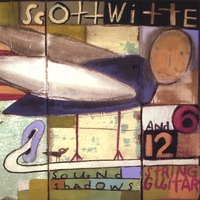
Scott is a Milwaukee-born guitarist, currently residing in Washington state. Scott remains a relatively unknown quantity in the world of fingerstyle guitar. He’s bound to gain some purchase with “Sailor’s Dream”, his standout track on the aforementioned Numero Group compilation, an animated little tune which owes no small debt to the playing of Leo Kottke. Witte’s debut album, also titled Sailor’s Dream and originally released in 1980, is still pending reissue, but fans of six and twelve-string acoustic guitar music would do well to seek out Sound Shadows, his 2007 collection of originals. Recorded between 2002 and 2007, Scott’s sophomore album sees the guitarist composing and performing with astute passion and creativity, picking up where “Sailor’s Dream” left off, but with an appreciable evolution of technique, harmony and song structure.
The album starts off with “Song of the Crow”, and an eye-roll inducing sample of, you guessed it, a loud crow “KAW!” My first instinct : “How much effort would it take for me to manually edit that out of the MP3 version, so I never have to hear it again?” All is forgiven, though, when Scott launches into the song itself, which is a finger-picking tour-de-force, and a great introduction to the elements of his style. A forlorn, minor-key meditation snowballs into a gorgeous set of guitar patterns, effortlessly moving back and forth between conventional and odd time signatures. It’s quite a trip, and sets the bar very high for the rest of the record.
Scott Witte – “Song of the Crow” .
“Time Enough” features some percussive fret-board whacking which segways into a 70’s-rock inspired strumming section. “Bounce” should appeal to fans of uplifting, major key picking motifs. “Sweet Reminisce” and “Land of the Setting Sun” are slow, minor-key dirges, and “Land…” contains some interesting techniques that you don’t hear very often, such as fretting the high string on the side of the neck to create high-pitched hammer-on effects, a la Davy Graham. The interwoven strumming, mournful basslines and unexpected chord changes also put me in mind of Peter Finger’s classic “Wishbone Ash”.
“One Last Time” is all joy and effervescence, the buoyant chord clusters being played in an unusual 7/8 pattern. It’s a real showcase for Mr. Witte’s clean right hand technique, but it also illustrates how he transcends the American Primitive style by thinking about the voice of the entire chord, rather than droning two or three notes and throwing down a simple repeating melody over the top.
Scott Witte – “One Last Time” .
At this point in an album, and with so much ground covered, one might start to worry about the well of ideas beginning to run dry… but Scott is just hitting his stride. Sound Shadows reaches it’s creative apex with “Inward Journey”, a composition that cycles through many movements, each more striking than the last. Much like James Blackshaw, one of the better-known modern-day purveyors of the long-form acoustic guitar song, Scott deftly picks his way through some gorgeous groups of chords, alternately accentuating notes in every register. That Mr. Witte is a virtuoso shouldn’t be a mystery to anyone at this point, bouncing back and forth between finger-rolls, time signatures and melodic snippets with the greatest of ease.
Genre-blurring acoustic guitarist Scott Witte
The album begins to wind down with “Walking On Air”, which revisits the sad, dirge-y mood of some of the earlier tunes. A short poem, “One Day Came a Crow”, reminds us of the loose concept of the album before closer “Prayer For Peace”, a very pretty pattern-picking invention in 5/8.
Though the few quirky “New Age” devices/trappings (the crow theme, the spoken word, etc.) at times threaten to cheese-up the proceedings (I know, right? Such a literate review and the best I could come up with was “cheese-up”), they prove minor distractions, relatively benign in the greater scheme of things. Sound Shadows is a serious, and seriously accomplished guitar album. The recording quality is very good indeed, the 12-string numbers featuring nice, thick close-micing, while the 6-string compositions benefit from the added sparkle of a little electric pickup mixed in. It is no small accomplishment that this group of songs, recorded intermittently over a five year period, are so of-a-piece… this collection could be sequenced any number of ways and would be no worse for the wear, a testament to Scott’s ability to keep things consistently varied and exciting. Though Scott Witte has been off the radar for some 28 years, with Sound Shadows he proves that he is not only in step with the current acoustic guitar scene, he also has the potential to be one of its leading lights.
Over the last couple of weeks, I’ve gotten to know Denis Turbide, a very fine fingerstyle guitarist from up Canada way. Denis has a self-titled, self-released CD out now… you can read the Work & Worry review here. The man also obliged W&W with a nice interview, presented below.
W&W : How old were you when you started playing guitar?
Denis : I was 13 years old when my parents got me a classical guitar for Christmas, and I took lessons for a few months after that.
W&W : When did your interest in fingerstyle guitar develop? Please talk about your early influences… what moved you to work in the style?
Denis : There was always fingerstyle, right from the start. It was a classical guitar my parents had given me, after all. My dad was a classical/opera guy. He sang on French-Canadian radio and early TV with choirs when he was younger. He wanted me to play classical guitar.
My first teacher taught me Beatles and Supertramp…the pentatonic scale. I had a classical teacher after that first summer but I didn’t like reading music. At the same time, I was listening to, and trying to learn, a lot of Simon and Garfunkel, Cat Stevens, Beatles, Led Zeppelin, James Taylor, Neil Young, America… obviously anything acoustic. Jimmy Page’s acoustic playing is still some of my favourite music.
W&W : Did your dad enjoy the rock and pop music that you were getting into? Could he appreciate the stuff you were working to learn?
Denis : Dad was a real Bach, Beethoven, Vivaldi, Rossini, Leoncavallo kinda guy. Glenn Gould, Yehudi Menhuin, Mario Lanza, Pavarotti, Beverly Sills, Maria Callas… Pop [music], when he was young, was Elvis and Chuck Berry, but Dad didn’t dig it too much. Classical music did rub off on me, though. I love hearing Bach especially. Some of the most incredible and powerful music ever written. All that said, I’m sure he could sing a few Beatles tunes…
W&W : So you gave up on the lessons pretty early on, and decided to follow your ear? How long was it before you switched over to steel strings?
Denis : The lessons I did for about 8-9 months altogether, over the course of about a year and a half. I learned fast and nobody ever had to force me to practice. I knew a lot of chords, found changes and learned new songs all the time. The next guitar I got after 2 years with the classical was a 12-string. I guess I didn’t play much fingerstyle on it, but I’m sure I played some… we’re talking some 25+ years ago.
W&W : Have you always flown solo, or did you spend any time playing in groups?
I wasn’t ever really in a group. There was a duet for while, over a decade ago, but since then it’s been pretty much me.
W&W : What tunings do you use on your recent s/t CD?
Denis : “A Little Bit” is in standard, “Derivatives” is dropped D, “After the Battle” is in DGDGBbD (open G min) and then DADGAD for “Samuel”, “Havre-aux-maisons” and “Firstborn”. My new tune, “That Face”, is in open G or DGDGBD.
W&W : You have a lot of YouTube hits and a lot of people requesting TABs for your songs… it has obviously been very good exposure for you, but how do you feel about the internet and social networking sites (Myspace, etc) and how it relates to the essence of playing guitar? Do you think it’s a natural progression from learning about guitar through books, concerts and albums?
Denis : How it relates to the essence of playing the guitar? Natural progression? Not sure about that but it’s been helpful getting the music out there, [though] obviously it does take up a lot of time getting things together. There are so many different sites now as well. How does anyone choose the one(s) that will get the most exposure? They all want you to join their site and all of them say that they will get you noticed….blah, blah, blah.
It is fun being an indie artist, though. Everything I’ve acheived so far is all because of the effort I put into it. The fact that people actually ask for my tabs is still a bit mindblowing for me, though. Sure, I’d love for more people to hear my music and to love it, but the fact that some out there want to actually learn my stuff is pretty exciting.
W&W : What was the process of getting the TABs together?
Denis : I checked around online looking for someone who tabs out tunes as it would have taken me a long time to do it. Writing out a few bars on some tab paper with a pencil and doing a whole tune on a computer are two different things. Alois Kleewein checked out the tunes… he really liked “Samuel”. He sent me some Tabledit previews, then he ran them through some software he’s got. They came out pretty nice. He plays in a funk band in Austria and we’ve only ever communicated online.
W&W : Talk a little bit about the guitars you’re using, string gauges, fingerpicks or no? Do you use the ring finger when you pick, thumb and two fingers, no particular approach?
Denis : I’ve been playing Larrivées for the last few years. Great guitars. Late last year, some members of the Larrivée online forum came up with some specs for a custom model that I was really interested in. It’s a smaller version of their proprietary L model, an LS, but they made it with a 12 fret neck, which I love. Mine has an Italian spruce top and mahogany back and sides. Outstanding.
Denis' Limited-Production Larrivée LS
For the CD, I used an L-03R and OO-50, both Larrivées and both I no longer own. The new LS I used for [the new recording] “That Face”. Uncoated D’Addarios are pretty much what I use when it comes to strings. The plain old EJ16, phosphor bronze light gauge. Their quality is consistent, they’re cheap and everyone has them in stock pretty much all the time. I’ve never been able to use finger/thumbpicks. I use a combination of flesh and nail when it comes to the picking, and I do use the ring finger as well. When I used to teach, I would tell the students to use the ring finger for the first string, middle for the second, index for the third and the thumb was for the top three. But then, no rule is written in stone.
W&W : Earlier this year, you talked about pursuing gigs again, after a pretty good hiatus… how has that been going? Do you see any touring in your future to promote this or future releases? Any upcoming gigs to report?
Denis : I would love to tour and stuff but I’ve got shared custody of my 3 and 6 year old sons, a full-time job, a mortgage… responsibilities. I’m not 20 anymore either! I should be more proactive, more aggressive but I’ve got so much going as it is. I’d love for this to become a career but, as everyone knows, the music business isn’t exactly a steady job with a regular paycheck. I have a regular monthly gig in Ottawa, Ontario at a pub called Woody’s. Great place. I started playing the open mic on Mondays about 2 years ago. It’s a relaxed, no pressure kind of place.
No future releases in the works right now but that could change if I come up with something new.
W&W : What cover songs are in your current repertoire? Which songs, cover versions or originals, do you find the most challenging to play?
Denis : My repertoire includes just about anything I can remember! I’ve been learning songs and pieces for nearly 30 years so there’s a lot that I forget I know how to play. Some of my favourites are up on YouTube now… “Little Martha”, “Never Going Back”, “That’s the Way”, and “Take Five”. I do a fingerstyle/vocal version of “Whiter Shade of Pale”, “Fragile” by Sting… I’m a big Beatles fan, so I do a bunch of their tunes like “Blackbird”, “Norwegian Wood”, and “You’ve Got To Hide Your Love Away”. I do a couple of [Pierre] Bensusan tunes, John Renbourn’s “Luke’s Little Summer”… that’s one of my all-time favourite pieces on the guitar.
W&W : Your picking style seems to have a healthy dose of American Primitive influence (Kottke, Fahey, Takoma Recs… steady boom-chick with melodies in the high strings, etc..) Would you say that that was an important influence, and have you kept an eye on the current crop of American Primitive-style players?
Denis : Well, I started learning the alternating bass thing way back with tunes like “The Boxer” and “Dust in the Wind”… still play those live too! But Leo Kottke, Fahey… amazing players. I don’t really play any Kottke tunes but there are some that I love… anything off of 6 and 12 String Guitar… wow, what a great album!! Jerry Reed’s “Heavy Necking” book… great stuff for any picker in there! I’m not really familiar with much new music/players these days. It appeals to me but I just can’t seem to find the time to really listen and enjoy. I barely have time to sit and play myself!
W&W : Your children seem to be one of your biggest inspirations. Do you think your children might follow your lead and become players?
Denis : My kids are my life. I’ll love them no matter what. I’m not sure if they’ll ever want to play, let alone want to play with the old man! I just want them to be happy with whatever they choose to do. That’s all any parent can hope for.
 by Raymond Morin





 WORK & WORRY