Category Archives: Articles

Interview : Sam Moss

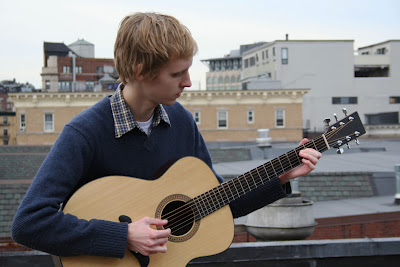
SM on Building 1I first became aware of Sam Moss’ playing via Tompkins Square’s Imaginational Anthem Vol. 4.  Sam fit right into that album’s Takoma-leaning tracklist, and much of Sam’s music that I’ve heard since has had a pronounced American Primitive approach…  his double-thumb, spare melodies and pretty pattern picking not only invoke the music of John Fahey and Peter Lang, but also modern-day interpreters of the genre like Glenn Jones and the late Jack Rose.  I recently caught up with Sam to talk about his new release, Eight Constructions.

W&W : Talk about how you got started in music, some of your early influences.

Most of my early influences came from the music my family listened to. My early memories involve Marvin Gaye, Stevie Ray Vaughan, Mozart and Benny Goodman. My parents are big music appreciators and my grandfather loved big bands. The joy he got from listening to Goodman, Count Basie or Artie Shaw was one of the main reasons that I wanted to play music. He was an artist and he used to have a cymbal in his studio so that he could keep time while blasting his records! I initially wanted to play the clarinet, but I ended up with a violin in my hands.

W&W : When did you first start playing acoustic guitar?

When I was something like thirteen. I favored electric for a long time, until I got into jazz a few years later. I started exploring the possibilities of solo acoustic playing, fingerstyle, etc, a few years ago.

W&W : Please describe your primary guitar, how you got it, how long you’ve had it, etc.

It’s a Tacoma DR12, made sometime around 2000, before the company was bought by Fender. I picked it up used a few years ago at a Guitar Center. Almost all the Tacoma’s made around that era have a finish flaw on the back and sides that causes little air bubbles to spread all over. Mine has it really bad and the finish is chipped all around the sides and is continually getting worse. Tacoma makes a pretty ugly guitar to begin with and the finish issue really puts it over the top. But it’s a great sounding dreadnought and the price was right… it has character. Continue reading
Interview : Maneli Jamal

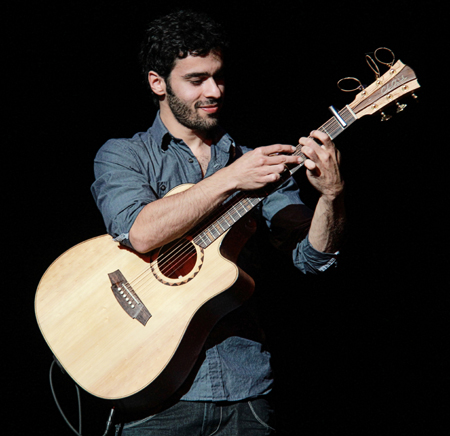
maneli-jamal_picManeli Jamal is a prodigious young fingerstylist, currently residing in Toronto, Canada. He works in the contemporary, highly physical two-hand style (lots of fretboard tapping with the picking hand) popular with a lot of young players these days, but there are several things that set Jamal apart from the multitudes of Andy McKee hopefuls who play the virtual YouTube circuit.

To say that Jamal’s technique is advanced would be a huge understatement. There aren’t many players in this style that have Jamal’s balance of power and sensitivity, nor his breadth of ideas. His rhythmic concepts can be alternately short and dense, or explored carefully through several movements, as in the four part suite from which The Ziur Movement album takes its name. Jamal has absorbed a number of musical styles, and he is able to seamlessly incorporate jazz, flamenco, classical and Persian ideas into his original compositions. The resulting pieces are very impressive, both technically and musically, and his CD is one of my favorites in the contemporary style.

I recently conducted this email interview with Jamal.

W&W : Let’s talk about the evolution of your fretting hand. You played in punk and metal bands when you were younger… would you say that that’s where you built up your strength and dexterity? Talk about your beginnings in guitar, and some of the early inroads you made toward your current (high) level of technique. Which players put you on the path to your current hybrid style?

When I started to play guitar I had already played violin for a few years learning from my father, a master Persian violinist. That definitely made learning the technical side of the guitar easier at first, especially the coordination between the hands. The great thing about punk and metal playing is that it’s fast and fun as hell to play for anyone starting the guitar.

Because I was self taught I used to be the kind of player that didn’t worry too much about accuracy but rather speed and what sounds cool, which was what punk music to me was all about. Unfortunately, I didn’t teach myself the discipline of accuracy and slow practice until years later. The guitarists of Thrice and Iron Maiden really influenced me in the punk / metal genre. I felt like I had reached a plateau after 3 years of playing that genre in my right hand picking. I thought the guitar pick was the best and most efficient way of playing the guitar… little did I know. I got into the likes of Al Dimeola and that opened up a whole new world for me. Continue reading

Interview : William Tyler

Late last year, we reviewed William Tyler’s excellent Tompkins Square debut Behold The Spirit. I recently caught up with William to talk about the making of the record, how he got into guitar, and his upcoming tour with Michael Chapman.

W&W : Talk a little about how you got started in guitar… how long have you been playing, what got you started, and your early influences.

Well I had the benefit/burden of growing up in Nashville, both around a lot of older musicians and a musical family. My father is a country songwriter and he was drawn to Nashville in the mid seventies, back when country singers bragged about smoking pot and reading books, as opposed to now when it’s all about trucks and patriotism.

I started playing guitar when I was a teenager, in spurts at first because I was more interested in drums and piano. I was also somewhat of a late bloomer when it came to rock music; I didn’t start buying rock records until I was fourteen or fifteen. Early stuff that influenced me was REM and Peter Buck, especially all the cross picking he did, the country style stuff in Rockpile and Dave Edmunds, and then stuff like the Sex Pistols and Ramones. I think Physical Graffiti was the first record I heard where I wanted to pick out an open tuning. Continue reading

Interview : Chris Weisman “Nonmusical Patterns”

A little while back, I received a very interesting package from my friend Patrick Borezo, an artist, musician and show promoter from Western Massachusetts.  It contained a small, beautiful paperback book called Nonmusical Patterns and their Musical Uses, written by Chris Weisman, a guitarist who has recorded extensively for Greg Davis’ Autumn Records, and is also a member of Happy Birthday (Sub Pop Records).  Patrick and his wife Amy printed and assembled the books, and are releasing it on their own Radical Readout Press.

It’s an interesting idea, to be sure… a collection of non-conventional scale patterns, chosen on their visual rather than their musical merits. I conducted the following email interview with Chris, to find out more about the project.

W&W : What inspired you to write the book?

In 2003, I started noticing more visual stuff happening on the fretboard, mostly when I was playing changes, playing over standards. Me and my buddy Bryan Bergeron-Killough (also a guitarist) used to have these long sessions every night when we both lived in Portland, Maine. I started getting interested in “scales” that would work visually (like the pattern is complete and strictly in the visual realm of dots on a grid, you don’t need to know anything about music at all to see them) but also be musically somewhat conservative in terms of pitch collections; the pitches in Nonmusical Patterns are the same as in conventional scales (or close) but due to this visual compass that’s also being respected, there are leaps all over the place. And the 2 octaves that fit roughly in a guitar position are different, usually when you play a scale it’s the same notes in every octave (and the scales don’t really look like anything). All this stuff is in the introduction. I started the book in the spring of ’05 and finished it 2 years later. Continue reading

Bert Jansch Visits Pittsburgh!

Raymond_Bert

Last Friday night was a night that I had been anticipating for a very long time. After two illness-related cancellations in the last two years, legendary Scottish guitarist Bert Jansch finally made it to Pittsburgh, one of only a handful of US performances this fall. The man should need no introduction, but for the unfamiliar, Bert Jansch came to prominence in the British folk and blues revival of the 1960’s, both as a solo artist and a member of the jazz/folk fusion group Pentangle. His playing and songwriting have been enormously influential in the folk world and beyond, and his praises have been sung by everyone from Led Zeppelin’s Jimmy Page (who pinched Bert’s arrangement of the traditional “Blackwaterside”, and without crediting him) to Neil Young, for whom Bert served as opening act on his last tour.

On this latest trek, Bert was headlining, and his support was Pegi Young (Neil’s wife) and her band, The Survivors, who were all seasoned west coast session musicians. The setting was the First Unitarian Church, which proved a great sounding venue for both Pegi Young’s country rock and Bert’s solo acoustic set. I wasn’t sure how many people would be attending the show, so I purchased tickets well in advance, not wanting to chance a sell-out. As it turns out, there were a fair number of empty pews that night, which I considered mind-boggling… this was Bert Jansch!!! How many times was he going to come back to Pittsburgh?! I didn’t dwell on it for very long… being a friend of the promotor, I knew that Bert would get paid no matter who showed up, and the modest crowd (100-125 people, maybe?) made for a memorable, intimate night. Continue reading