 John Renbourn is a wonder. His recording career began in England during the mid-sixties, just as the late Davey Graham was blazing new trails with the acoustic guitar. John followed Davey’s lead, performing on his early Transatlantic albums with a sense of abandon, cleverly weaving together musical styles and traditions from around the globe. Over time, Renbourn’s playing became more measured but also increasingly detailed, sometimes blurring the line where folk music ends and classical music begins. While his discography features a wide variety of modes and collaborations, his solo albums from the late seventies, The Hermit and The Black Balloon in particular, feature expansive long-form guitar instrumentals that are among his most ambitious and best works. The latest album, Palermo Snow (Shanachie Records, 2010) belongs to that lineage… I was excited to discover it included an arrangement of Erik Satie’s “Sarabande,”¹ as I’ve been absorbed in Satie’s music recently and, more importantly, imagined that interpreting it would be an interesting change of pace for Renbourn.
Satie’s piano compositions are generally regarded as precursors to ambient music, which he referred to as musique d’ameublement, or “furniture music.” Their quality is atmospheric, repetitive, slightly dissonant. Satie is identified with the avant-garde for his later associations with Dada, though his early compositions are often referred to as “impressionist.” The series of three “Sarabandes,” introduced in 1887, just a year prior to his best known work, the “Gymnopédies,” indeed have a drifting, romantic quality. Here is the late French pianist’s Jacques Février’s rendition of Satie’s “Sarabande No.1”²:
A “sarabande” is a dance in triple meter. From what I’ve gathered, it was developed in Spanish colonies in the sixteenth century and later banned in Spain for its sexual undertones. The dance was revived and commonly used as movement within a suite during the Baroque period, when the German music theorist, Johann Matthesson, declared that it “expresses no passion other than ambition.”³ It’s easy to imagine how the peculiar reputation and history of this dance would appeal to Satie, whose sense of humor is well documented. One even wonders if the circularity of his “Sarabandes” was intended to be satirical. Interestingly, John Renbourn included an electric guitar rendition of a Bach “Sarabande” on his fourth album, The Lady and the Unicorn. Despite the heavy vibrato effect, it sounds more formal than Satie’s “Sarabandes,” and I suspect provides a better sense of a typical, Baroque version of the dance:
Adapting ambient music to the guitar provides one with an opportunity to obsess over each individual note or chord; to allow the overtones that occur during sustain, as well as fret and room noise, to become the “detail” of the piece. The timbre of steel string guitar seems particularly well-suited to the task, especially compared with classical guitar. Solo fingerstyle guitar music, by contrast, is a show of dexterity, where bass and melody lines interact in a complex, sometimes dizzying manner. Renbourn is regarded as a master of fingerstyle form, and would seem to reside in a different ballpark from the ambient musician. I know from my own attempts to feather ambient pieces into a fingerstyle repertoire that the adjustment in mindset is not easy to manage in one sitting. Not to suggest that John Renbourn is uninterested in tonality, it seems reasonable to point out that the opportunities for him to really fuss over it have been somewhat scarce in his music. I can’t think of many examples from his recorded works that resemble Satie’s music, save perhaps the duet rendition of the Charles Mingus’ “Theme from The Shoes Of The Fisherman’s Wife Are Some Jive Ass Slippers” with Stefan Grossman, which has impressionistic qualities.
Renbourn’s take on Satie’s “Sarabande” is similar in tempo to the Février example. However, one gets the sensation, especially early on in the recording, that he feels slightly impatient and is struggling to lock in with the odd cadences of the piece:
In fact, it’s the sense of struggle that I find most appealing about this performance. The voicings he selected for the arrangement also have a mundane quality that I think befits the piece. If there’s one flaw, it would be the heavy handed use of artificial reverb on the recording, which I think obscures rather than flatters some of the details of John’s performance. Nonetheless, I find it encouraging that this revered guitar player, who has accomplished so much with the instrument, was willing to venture into potentially uncomfortable musical territory to expand his boundaries, if even only slightly. While this article focused only on one track, Palermo Snow is a certainly multi-faceted album worthy of celebration by guitar music fans.
¹ Renbourn’s arrangement is of Satie’s “Sarabande No. 1”
² from Piano Music of Erik Satie (Remastered, 2011)
³ from Der Vollkommene Capellmeister (1739)
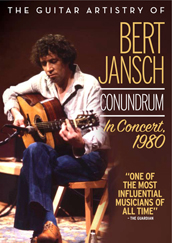 All apologies, I’ve fallen very behind on my reviews this year… though it’ s not due to a dearth of worthy releases! Since it’s been a little while since I’ve gushed about the legendary Bert Jansch, I thought I would talk about his latest release, In Concert, 1980, out now on SGGW. From what I understand, this show had already made the rounds on the VHS circuit (thanks Yair!) but this new issue, part of Stefan Grossman’s Guitar Artistry series, features bonus footage from a second concert, as well as a short documentary entitled A Man and His Songs. The material and performances on offer here nicely bridge the gap between Jansch’s classic solo period of the mid ’60s and the sober, welcome renaissance of recent years… and for that I consider it a document of utmost importance… but In Concert is also a rare glimpse of Jansch at his collaborative best, playing both new compositions and compelling arrangements of old favorites, with players who not only have the chops to keep up with the unpredictable Scottish guitar hero, but also carry a genuine affection for the man and his art.

 WORK & WORRY